🔍 Search Best Services

Popular Searches:

July 30, 2012

Sophocles

Sophocles

Second of the three greatest ancient Greek writers of tragedy.
  • Full Name: Sophocles
  • Birth: 496 B.C. ?
  • Death: 406 B.C. ?
  • Cause of death: ?
  • Place of Death: Athens
  • Place of Birth: Colonus Hippius (now part of Athens)
  • Buried at: Family tomb near Deceleia
  • Father: Sophillus
  • Mother: ?
  • Siblings: ?
  • Marriage: ?
  • Spouse: Nicostrata (First Wife), Theoris (Second Wife)
  • Number of Children: 2 legitimate sons: Iophon (by first marriage), Ariston (by second marriage) and 3 illegitimate sons
  • Education: ?
  • Known for: bringing change in the spirit and significance of tragic plays by cleverly portraying the nature of man, his problems, and his struggles as the foremost interest while keeping the traditional religion and morality as the central source of theme
  • Criticised for: not dealing with religious problems as Aeschylus had nor with intellectual ones as Euripides had done
  • Influences: Euripides, Aeschylus
  • Influenced: Heiner Müller, William E. Connolly, Grigol Robakidze, Dominik Smole, Malcolm Lowry

Quote:

“There are many wonderful things, but none is more wonderful than man.” Sophocles, Antigone

Major Themes:

  • Fate
  • The limits of free will
  • Divine laws
  • Pre-ordinance
  • Justice
  • Revenge
  • Pride
  • The threat of Hasty judgment
  • The threat of tyranny
  • False optimism
  • Ignorance
  • Madness
  • Human strife and struggle
  • Human sufferings

Notable Works:

Extant Plays
  • Oedipus Tyrannus (430 to 415 B.C.)
  • Oedipus at Colonus (produced posthumously in 401 B.C.)
  • Antigone (after 441 B.C.)
  • Electra (430 to 415 B.C.)
  • Trachiniae (after 441 B.C.)
  • Ajax (c. 451-444 B.C.)
  • Philoctetes (409 B.C.)
Fragmentary Plays
  • Aias Lokros (Ajax the Locrian)
  • Aias Mastigophoros (Ajax the Whip-Bearer)
  • Aigeus (Aegeus)
  • Aigisthos (Aegisthus)
  • Aikhmalôtides (The Captive Women)
  • Aithiopes (The Ethiopians), or Memnon
  • Akhaiôn Syllogos (The Gathering of the Achaeans)
  • Akhilleôs Erastai (Lovers of Achilles)
  • Akrisios
  • Aleadae (The Sons of Aleus)
  • Aletes
  • Alexandros (Alexander)
  • Alcmeôn
  • Amphiaraus
  • Amphitryôn
  • Amycos
  • Andromache
  • Andromeda
  • Antenoridai (Sons of Antenor)
  • Athamas (two versions produced)
  • Atreus, or Mykenaiai
  • Camicoi
  • Cassandra
  • Cedaliôn
  • Cerebros
  • Chryseis
  • Clytemnestra
  • Colchides
  • Côphoi (Mute Ones)
  • Creusa
  • Crisis (Judgement)
  • Daedalus
  • Danae
  • Dionysiacus
  • Dolopes
  • Epigoni
  • Eriphyle
  • Eris
  • Eumelus
  • Euryalus
  • Eurypylus
  • Eurysaces
  • Helenes Apaitesis (Helen's Demand)
  • Helenes Gamos (Helen's Marriage)
  • Herakles Epi Tainaro (Hercules At Taenarum)
  • Hermione
  • Hipponous
  • Hybris
  • Hydrophoroi (Water-Bearers)
  • Inachos
  • Iobates
  • Iokles
  • Iôn
  • Iphigenia
  • Ixiôn Lacaenae (Lacaenian Women)
  • Laocoôn
  • Larisaioi
  • Lemniai (Lemnian Women)
  • Manteis or Polyidus (The Prophets or Polyidus)
  • Meleagros
  • Minôs
  • Momus
  • Mousai (Muses)
  • Mysoi (Mysians)
  • Nauplios Katapleon (Nauplius' Arrival)
  • Nauplios Pyrkaeus (Nauplius' Fires)
  • Nausicaa, or Plyntriai
  • Niobe
  • Odysseus Acanthoplex (Odysseus Scourged with Thorns)
  • Odysseus Mainomenos (Odysseus Gone Mad)
  • Oeneus
  • Oenomaus
  • Palamedes
  • Pandora, or Sphyrokopoi (Hammer-Strikers)
  • Pelias
  • Peleus
  • Phaiakes
  • Phaedra
  • Philoctetes In Troy
  • Phineus (two versions)
  • Phoenix
  • Phrixus
  • Phryges (Phrygians)
  • Phthiôtides
  • Poimenes (The Shepherds)
  • Polyxene
  • Priam
  • Procris
  • Rhizotomoi (The Root-Cutters)
  • Salmoneus
  • Sinon
  • Sisyphus
  • Skyrioi (Scyrians)
  • Skythai (Scythians)
  • Syndeipnoi (The Diners, or, The Banqueters)
  • Tantalus
  • Telephus
  • Tereus
  • Teukros (Teucer)
  • Thamyras
  • Theseus
  • Thyestes
  • Troilus
  • Triptolemos
  • Tympanistai (Drummers)
  • Tyndareos
  • Tyro Keiromene (Tyro Shorn)
  • Tyro Anagnorizomene (Tyro Rediscovered).
  • Xoanephoroi (Image-Bearers)

Did you Know?

Despite being a commoner, his father Sophillus was a rich man; his wealth was derived from the ownership of slaves employed in various manufactures, especially armour

Sophocles was well educated in all of the arts prevailed in old Greek system, including poetry, dance, gymnastics, philosophy, music, mathematics, astronomy, law, athletics and military tactics

He was well versed in Homer and the Greek lyric poets

Sophocles was an active, engaging man throughout his whole life; he was known as the “Attic Bee” for his diligence

Besides Aeschylus and Euripides, Sophocles is that great Greek tragedian whose work has survived into modern times

Sophocles was the younger contemporary of Aeschylus and the older contemporary of Euripides

In 468 B.C. at the age of twenty-eight Sophocles defeated Aeschylus at the Dionysian dramatic festival; with this victory, Aeschylus left for Sicily and Sophocles’ dramatic career started and continued to secure a number of consecutive victories

During his career he never won less than second prize

In 441 B.C. Euripides defeated Sophocles at the Dionysian dramatic festival

 He was the most-awarded writer in the dramatic competitions of ancient Athens; his total victories are greater than the combined wins of Aeschylus and Euripides

Now a days his reputation firmly rests upon Oedipus Tyrannus, the tragic story of the mythical figure Oedipus, whose name was adopted by Freud to explain his concept of Oedipus Complex

At the age of 16, due to his youth, good looks, and performing ability, he was picked to a paean (choral chant) about the victory of the Battle of Salamis

In total, Sophocles wrote 123 plays, of which only 7 complete tragedies survive these days; besides, fragments exist for 80 to 90 other pieces

Oedipus at Colonus, the second of his best pieces was produced posthumously

Sophocles was the only playwright of his time who did not perform in all of his plays, owing to his weak voice

Sophocles married twice. His first marriage was with a woman named Nicostrata, by whom he became the father of Iophon. Somewhat late in life he formed a connection with a certain Theoris, a woman of Sicyon, by whom he had a son called Ariston

It is assumed that Sophocles had three other illegitimate sons, though nothing is known about them

His two sons: Iophon and Ariston were also writers of tragedy

Towards the end of his life, Iophon sued against Sophocles to prove him mentally incompetent in order to get the administration of his property. To prove his sanity, Sophocles recited a portion of the then unpublished Oedipus Coloneus. He was off the charges since the jury could ascertain that no incompetent person could write such beautiful words

Sophocles had a strong appetite for carnal pleasure and it remained the same until he was very old

Akin to many Greek men of that time, Sophocles had a liking for handsome youths

Towards the end of his life, Sophocles fell in love with the courtesan named Archippe, whom he made heiress of his property but ultimately she lost it to Sophocles' relatives

When Archippe’s former lover learnt about her relationship with the old Sophocles, he wittily described it through the following lines:

“like a night-owl among the tombstones,
 like a horned owl over corpses,
 so my girl now sits with Sophocles.”

A series of myths exist about the manner of his death. According to some, he was choked by eating grapes sent him by the actor Callippides at the time of the Anthesteria. Some others said that he died while reading Antigone aloud by trying to deliver a long sentence without taking a breath. Again, few others ascribed his death to excessive joy at the success of his Antigone in competition

After his demise, he was buried in the family tomb on the way to Deceleia, about a mile from Athens, and over his tomb the figure of a siren was erected

He was not politically active or militarily inclined, but the Athenians elected him twice to high military office

Besides being a tragedian, Sophocles was also an actor, a military commander, a field general, a priest, a politician, and a treasurer

He was very religious-minded and he transformed his home in worship place for the healing god Asclepius, while a temple was being built

References

Gill, N.S. “Sophocles.” About.com. 2012. About.com. 25 July 2012
< http://ancienthistory.about.com/od/sophocles/p/Sophocles.htm>.

K., Danny. “Sophocles.” Enloehs. 2012. Enloehs. 25 July 2012
< http://enloehs.wcpss.net/projects/west42002/sophocles8/bio.html>.

“Sophocles.” Wikipedia. 2012. Wikimedia Foundation, Inc. 25 July 2012
< http://en.wikipedia.org/wiki/Sophocles>.

“Sophocles.” Sophocles. 2012. Sophocles. 25 July 2012
< http://www.sophocles.net/listingview.php?listingID=21>.

“Sophocles.” Encyclopædia Britannica. 2012. Encyclopædia Britannica, Inc.
25 July 2012 < http://www.britannica.com/EBchecked/topic/554733/Sophocles>.

“Sophocles.” Evi. 2012. Evi Technologies Ltd. 25 July 2012
< http://ancienthistory.about.com/od/sophocles/p/Sophocles.htm>.

“Sophocles.” Ancient Athens. 2010. Ancient Athens. 25 July 2012
< http://www.ancientathens.org/people/sophocles>.

“Sophocles.” Theatre Database. 2012. Ancient Athens. 25 July 2012
< http://www.theatredatabase.com/ancient/sophocles_001.html>.

“Sophocles.” Greek Literature. 2012. Angela DeHaven. 25 July 2012
< http://atschool.eduweb.co.uk/>.

“Sophocles and Antigone.” 123HelpMe.com. 2000-2011. 123HelpMe.com.
25 July 2012 < http://www.123helpme.com/view.asp?id=5730>.

“Sophocles Biography.” Encyclopedia of World Biography. 2012. Advameg, Inc.
25 July 2012 < http://www.notablebiographies.com/Sc-St/Sophocles.html>.


July 12, 2012

Geoffrey Chaucer

Geoffrey Chaucer

14th century English poet, philosopher, courtier, civil servant and diplomat.
  • Full Name: Geoffrey Chaucer
  • Also Known as: Father of English Literature
  • Birth: 1343?
  • Death: 1400?
  • Cause of death: ?
  • Place of Death: ?
  • Place of Birth: London, England?
  • Buried at: Westminster Abbey, London
  • Father: John Chaucer
  • Mother: Agnes Copton
  • Siblings: 1 Sister (Katherine Chaucer)?
  • Marriage: 1366?
  • Spouse: Philippa Roet
  • Number of Children: 2 Sons ? (Thomas Chaucer and Lewis Chaucer) & 2 Daughters ? (Elizabeth Chaucer and Agnes Chaucer)
  • Education: ?
  • Known for: elevating the prestige of English as a literary language as well as increasing the range of its poetic vocabulary and metres
  • Criticised for: his lack of seriousness (According to Matthew Arnold)
  • Influences: Guillaume de Lorris (c. 1200 – c. 1240), Jean de Meun (c. 1240 – c. 1305), Dante Alighieri (c. June 1, 1265 – September 14, 1321), Guillaume de Machaut (c. 1300 – April 1377), Giovanni Boccaccio (June 16, 1313 – December 21, 1375), and Jean Froissart (c. 1337 – c. 1405)
  • Influenced: Thomas Hoccleve (c. 1368–1426), John Lydgate (c. 1370 – c. 1451), Sir Thomas Malory (c. 1405 – 14 March 1471), John Skelton (c. 1460 – 21 June 1529), Robert Henryson (c. 1425 - c. 1500), Edmund Spenser (c. 1552 – 13 January 1599), William Shakespeare (26 April 1564 – 23 April 1616), and John Dryden (9 August 1631 – 1 May 1700)

Quote:

“What is better than wisdom? Woman. And what is better than a good woman? Nothing. “Tale of Melibeus” (The Canterbury Tales)

Major Themes:

  • Courtly love
  • Romance
  • Sin
  • Social class
  • Corruption of the Church
  • Christianity
  • Patience
  • Decadence
  • Feminism
  • Sex and adultery
  • Male-female marriage
  • Justice and judgement
  • The human pursuit of transitory earthly ideals
  • The dilemma of fate verses free will

Notable Works:

  • The Book of the Duchess (about 1370?)
  • Troilus and Cressida (about 1385?)
  • The Canterbury Tales (about 1386?)
  • The Parliament of Fowls (about 1382?)
  • The Knight's Tale (from the Canterbury Tales) (about 1386?)
  • The House of Fame
  • The Legend of Good Women ( about 1386?)
  • Treatise on the astrolabe
  • Truth (about 1390?)
  • Gentilesse
  • Merciles Beaute
  • Lak of Stedfastnesse
  • Against Women Unconstant

Did You Know?

  • The historians are divided into their opinions about the exact date of Chaucer’s birth.
  • Generally it is assumed that he was born between 1343 and 1446.
  • The historians are in complete darkness about Chaucer’s death. According to one tradition, he died of natural causes, possibly tumor. Still another tradition relates that he was murdered by enemies of Richard II or his successor, Henry IV.
  • Geoffrey Chaucer grew up on Thames Street in London, England.
  • Little is known about his educational background. He probably attended a school attached to a local church named Saint Paul's Cathedral to have some education in Latin and Greek and may have studied law at the Inns of Court.
  • His father and grandfather were both London wine makers; several previous generations had been merchants in Ipswich.
  • Most possibly in 1366 he married a fellow courtier named Phillipa Pan.
  • It is assumed that Chaucer was fluent in several languages, including French, Italian, and Latin.
  • Since Chaucer was the first poet to write authoritatively in English, John Dryden called Chaucer "the father of English poetry," and honoured him as highly as the Greeks honoured Homer and the Romans honoured Virgil.
  • Although he spent most of his life in and around the court, he had to work a succession of jobs— as a page, a soldier, an esquire, a diplomat, a customs controller, justice of the peace, member of Parliament, Clerk of the Works of Westminster, Commissioner of Walls and Ditches, and Deputy Forester of the Royal Forest to support himself.
  • According to legal records, in 1380 Chaucer was accused of the raptus (which could mean either rape or kidnapping) of a woman named Cecilia Chaumpaigne. However, in court she dropped all of the charges and released him of all of his actions in the case of her rape.
  • After his death, he was buried in the South Transept of Westminster Abbey, which was definitely a rare honour for a commoner like him. Since then that very part became known as the Poet's Corner.
  • Chaucer's first published work was The Book of the Duchess, a poem of over 1,300 lines.
  • Although he wrote a number of stories and poems over the course of his lifetime, today his reputation chiefly rests upon The Canterbury Tales.
  • He never finished his masterpiece The Canterbury Tales and even the completed tales were not finally revised. Scholars are uncertain about the order of the tales. As the printing press had yet to be invented when Chaucer wrote his works, The Canterbury Tales has been passed down in several handwritten manuscripts.
  • In The Canterbury Tales, Chaucer's characters are psychologically so complex that the work has also been called by the scholars the first modern novel.
  • Chaucer was the first English writer to write in the language of the people, the vernacular English, rather than Latin or French, the languages used for most literary writings in the 1300s.
  • Chaucer contributed a lot to increase the prestige of English as a literary language and extended the range of its poetic vocabulary and meters.
  • He was the first English poet to use the seven-line stanza in iambic pentameter known as rhyme royal and the couplet later called heroic.
  • For the English Renaissance, Chaucer was the English Homer. Edmund Spenser paid tribute to him as his master and many of the plays of William Shakespeare show thorough assimilation of Chaucer's comic spirit.
  • His family name derives from the French term chausseur, meaning "shoemaker".
  • There’s a crater on the far side of the moon named Chaucer which has been named in honour of Chaucer.


References

“Biography of Geoffrey Chaucer.” GradeSaver. 1999-2012. GradeSaver LLC. 8 July 2012
< http://www.gradesaver.com/author/geoffrey-chaucer/>.

David, Alfred. “Geoffrey Chaucer.” Microsoft Encarta. DVD-ROM. Redmond: Microsoft, 2005.

 “Fast Facts about Geoffrey Chaucer.” Geoffrey Chaucer Information. 2003. Brendan Benson. 8
July 2012 < http://www.angelfire.com/mi3/chaucer/resume.html>.

“Geoffrey Chaucer Biography.” Bio.com. 1996–2012. A+E Television Networks, LLC. 8 July 2012
< httphttp://www.biography.com/people/geoffrey-chaucer-9245691>.

“Geoffrey Chaucer.” Wikipedia. 2012. Wikimedia Foundation, Inc. 8 July 2012
< http://en.wikipedia.org/wiki/Geoffrey_Chaucer>.

“Geoffrey Chaucer.” The Middle Ages Website. 2012. The Middle Ages Website. 8 July 2012
< http://www.middle-ages.org.uk/geoffrey-chaucer.htm>.

“Geoffrey Chaucer.” eNotes.com. 2012. eNotes.com, Inc. 8 July 2012
< http://www.enotes.com/authors/geoffrey-chaucer>.

Gray, Douglas. “Chaucer and the Growth of Vernacular Literature.” Oxford DNB.
2004-2012. Oxford University Press. 8 July 2012
< http://www.oxforddnb.com/public/themes/94/94766.html>.

“Little Known Facts about Geoffrey Chaucer.” Smithsonian Journeys. 2012. Smithsonian Journeys. 8 July
2012 < http://www.smithsonianjourneys.org/blog/2010/09/13/geoffrey-chaucer/>.

“Person Sheet: Catherine Chaucer.” Ancestry.com Community. 2012. Ancestry.com Community. 8 July
2012 < http://freepages.genealogy.rootsweb.ancestry.com/~barbpretz/PS01/PS01_316.HTM>.

“The Canterbury Tales and Other Works by Geoffrey Chaucer.” Librarius. 2012. Librarius.
8 July 2012< http://www.librarius.com/>.


July 6, 2012

Matthew Arnold

Matthew Arnold

Leading English poet, literary & social critic, and essayist of the Victorian age.
  • Full Name: Matthew Arnold
  • Birth: December 24, 1822
  • Death: April 15, 1888
  • Cause of death: Heart Failure
  • Place of Death: Liverpool
  • Place of Birth: Laleham, Middlesex
  • Buried at: All Saints' Churchyard, Laleham, Middlesex
  • Father: Thomas Arnold
  • Mother: Mary Penrose Arnold
  • Siblings: 6 (three sisters and three brothers)?
  • Marriage: 1851
  • Spouse: Frances Lucy Wightman
  • Number of Children: 6
  • Education: Rugby School; graduated from Balliol College, Oxford in 1844
  • Known for: his classical criticism on the socio-cultural matters of England, especially the manners of the class structure which was comprised of three major classes: the “Barbarians” (the aristocracy), the “Philistines” (the middle class), and the “Populace” (the lower class)
  • Criticised for: not incorporating sufficient original ideas of his own in the critical studies
  • Influences: William Wordsworth, John Keats. Goethe, Sainte-Beuve, and Cardinal Newman
  • Influenced: T. S. Eliot, Lionel Trilling, Harold Bloom, Robert Pinsky W. B. Yeats, James Wright, Sylvia Plath, and Sharon Olds

Quote:

“Our society distributes itself into Barbarians, Philistines, and Populace; and America is just ourselves, with the Barbarians quite left out, and the Populace nearly.” Culture and Anarchy (1969)

Major Themes:

  • Nature
  • Melancholy in life
  • Loss of religious faith
  • Loss of love
  • Sharp Discrimination between Intellectual and Moral Truth
  • Arnold's own essential homelessness in the Victorian world
  • Past present and future of Britain
  • Separation and hopelessness
  • Confusion in life

Notable Works:

  • The Strayed Reveller, 1849
  • Empedocles on Etna, 1852
  • Poems, 1853
  • Poems, Second Series, 1855
  • "The Modern Element in Literature," inaugural lecture at Oxford, November 1857
  • Merope, a Tragedy, 1858
  • On Translating Homer, 1861
  • The Study of Celtic Literature (lectures), 1867
  • Essays in Criticism (1st series), 1865
  • New Poems, 1867
  • Culture and Anarchy, 1869
  • St. Paul and Protestantism, 1870
  • Friendship's Garland, 1871
  • Literature and Dogma, 1873
  • God and the Bible, 1875
  • Last Essays on Church and Religion, 1877
  • Essays in Criticism (2nd series), 1888

Did you Know?

  • Matthew Arnold was born in 1822, the same year that Percy Shelley was drowned
  • He died in 1888, the same year that T. S. Eliot was born
  • Although Matthew Arnold began his literary career as a poet, nowadays he is chiefly remembered for his critical essays
  • Arnold invested only a quarter of his productive life to writing poetry
  • Even though Arnold is considered one of the major poets of the Victorian Era, behind Alfred Lord Tennyson and Robert Browning, he was not recognized in his own time
  • Matthew Arnold was 26 years old when his first book of poetry appeared
  • He published his first book of poetry The Strayed Reveller (1849) anonymously. Then he published his second book Empedocles on Etna (1852). But he was so dissatisfied with these books that ultimately withdrew them from circulation
  • As a lecturer Arnold was disappointing, both because of his awkward manner and the feebleness of his voice, which was inaudible to the greater part of his audience.
  • During travels in 1848, he met and fell in love with a French woman, but they did not marry.
  • Arnold went to 2 different Colleges: Winchester College and Balliol College.
  • After graduating from Balliol College at Oxford in 1844, Arnold accepted a teaching post at the university.
  • In 1857 Arnold was elected to the professorship of poetry at Oxford, and he held this post for the next decade. He was the first professor of poetry to give his lectures in English rather than in Latin
  • He was the Head chairman of Poetry at Oxford University.
  • He was a Private Secretary to Lord Lansdowne.
  • In 1851 he was appointed inspector of schools, a position he held until shortly before his death within two years
  • He died on a sudden heart attack in 1888 in Liverpool while walking with his wife to catch a tram to meet his beloved daughter, who was arriving on a boat from the USA
  • Several of Arnold's early poems express his hopeless love for a girl he calls Marguerite. Scholars have been unable to identify an original for this girl, and whether she existed at all is a question
  • Some of Arnold's most attractive poems are addressed to his children
  • Arnold himself could apprehend that his talent was not as great as the other major poets of his time, and therefore, he completely abandoned poetry during the airy heights of his career and tend to write literary criticism instead
  • He is often considered to be the founding father of academic criticism in English, and the principles for literary criticism
  • His longest poem is "Empedocles on Etna,"
  • Matthew Arnold had six children by his wife, three of whom died in childhood.
  • When Wordsworth died in 1850 Arnold published his "Memorial Verses" in Fraser's Magazine to pay a homage to the deceased poet

References

“Classic Literature Writer.” About.com. 2012. About.com. 20 June 2012
< http://classiclit.about.com/library/bl-bio/bl-marnold.htm >.

Cummings, Della. “Biography of Matthew Arnold.” Athens Academy. 2012. Athens Academy.
20 June 2012 < http://www.athensacademy.org/teachers/asweetapple
/2008/Cummings_PoetryWeb/bio.htm >.

Kunitz, Stanley. “Matthew Arnold: A Biography.” The Victorian Web. 2012. The Victorian Web.
20 June 2012 < http://www.victorianweb.org/authors/arnold/index.html>.

“Matthew Arnold.” Poets.org. 1997-2012. Academy of American Poets. 20 June 2012
< http://www.poets.org/poet.php/prmPID/88>.

“Matthew Arnold.” Yahoo Education. 2009. Yahoo! Inc. 20 June 2012 .
“Matthew Arnold Biography.” Dromo's Den. 2012. Dromo's Den. 20 June 2012
< http://www.dromo.info/arnoldmbio.htm >.

“Matthew Arnold.” MatthewArnold. 2012. Tangient LLC. 20 June 2012
< http://matthewarnold.wikispaces.com/Interesting+Facts >.

“Matthew Arnold (1822 - 1888) Short Biography.” Adnax Publications. 2012.
Adnax Publications. 20 June 2012 < http://www.adnax.com/biogs/ma.htm>.

“Matthew Arnold | Biography.” BookRags. 2012. BookRags, Inc. 20 June 2012
< http://www.bookrags.com/biography/matthew-arnold/>.


May 9, 2012

In Greek mythology, Pandora (Also called Anesidora: the sender of gifts) was the first human woman on earth, apart from the gods, goddesses, and human males. Zeus ordered Hephaestus (also spelt: Hephaistos; Roman equivalent: Vulcan) to create her to punish both Prometheus and humankind for the theft of fire from the chariot of Helios (Roman equivalent: Sol). Hephaestus moulded a perfectly shaped beautiful female figure with earth and water while Aphrodite (also called: Cytherea; Roman equivalent: Venus) posed as a model.

creation-of-pandora
Then Zeus breathed life into the clay statue. Zeus ordered all of the gods each to give her a gift. Accordingly, Aphrodite gave her unparalleled beauty, grace and desire. Hermes (Roman equivalent: Mercury), the messenger god, gave her a cunning, deceitful mind and a crafty tongue. Athena (Roman equivalent: Minerva) dressed her in a silvery gown, covered her face with an embroidered veil and adorned her hair with bright garlands of fresh flowers and an ornate silver crown. Besides, Athena also taught her needlework and weaving. Poseidon (Roman equivalent: Neptune) presented her a pearl necklace that would prevent her from drowning. Apollo taught her to sing sweetly and play the lyre. The Graces and Peitho (Roman equivalent: Suadela) gave her necklaces of gold. Zeus (Roman equivalent: Jupiter, also called: Jove) gave her an imprudent, mischievous, and idle nature. Hera (Roman equivalent: Juno) gave her the wiliest gift, curiosity. Finally, Hermes named her Pandora, which means “the one who bears all gifts", because each god gave her a unique gift. With all such splendid gifts and luxurious attire, Pandora almost looked like a goddess of Olympus. She was indeed the most beautiful mortal woman ever created.

pandora carried off by mercury

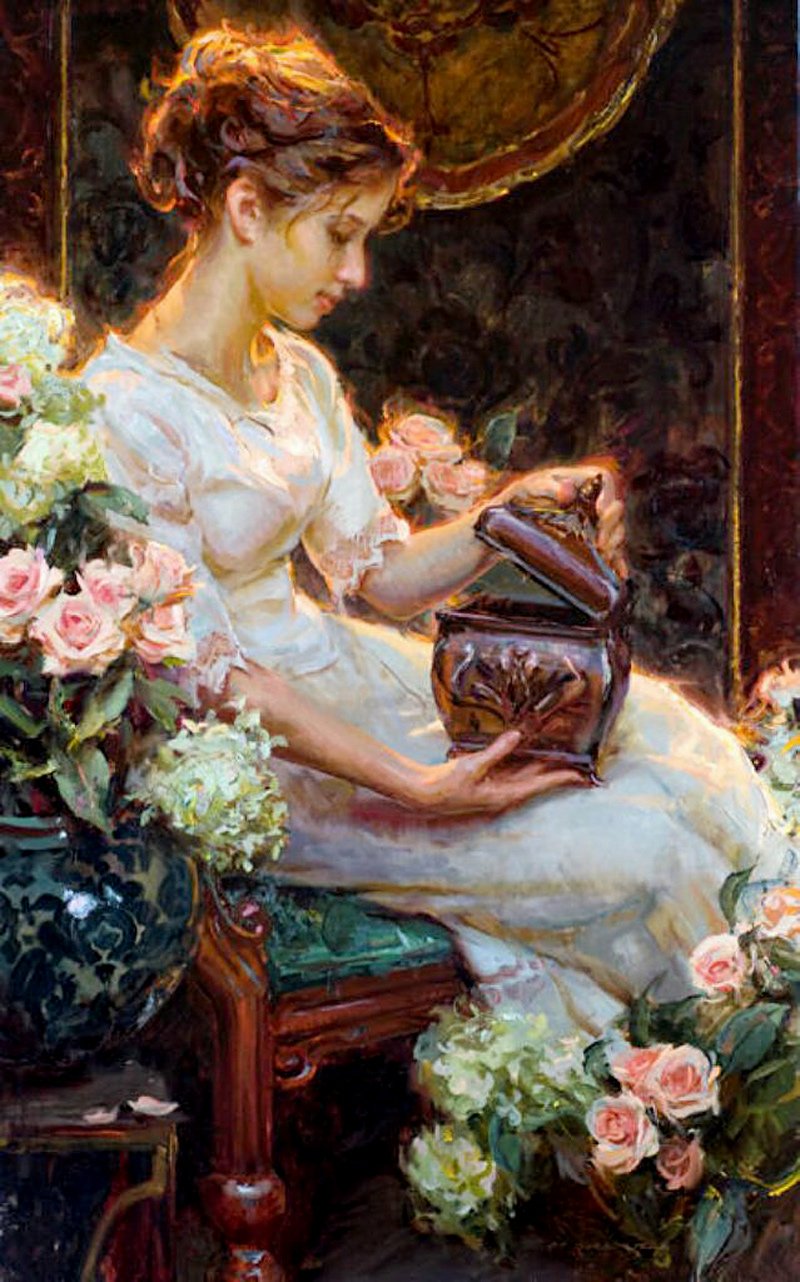
Ahead of sending her to earth, Hermes presented Pandora with an artistically crafted golden box. He told her that the box contained special gifts from Zeus. But he strictly forbade her to open the box under any circumstance. Zeus then ordered Hermes to take Pandora to Prometheus and offer her as his wife. Prometheus, who had the gift of foresight, became suspicious about Hermes’ grand entrance with lovely Pandora. Therefore, Prometheus refused to accept her under the excuse that she lacked prudence. Then Hermes took her to Epimetheus, the brother of Prometheus, to be his wife. Prometheus warned Epimetheus not to accept anything from the Gods. But upon first sight of Pandora, Epimetheus was totally enthralled by her beauty and forgot his brother’s warning. Consequently, he accepted her as his wife and the couple settled down for a happy conjugal life. But Pandora always wondered what was in the box. Pandora tried to repress her curiosity for long but subsequently failed to hold it anymore. She opened the box, and from it flew hate, anger, sickness, poverty, and every bad thing in the world. Pandora was scared, because she saw all the evil spirits coming out and tried to close the box as fast as possible, closing hope inside.

pandoras-box

Variations in the Story:

This popular myth appears in numerous versions. For instance, difference is seen with the box’s presenter, presentee as well as its opener. In some accounts it is mentioned that once Prometheus captured all the evil things in a box and gave it to his brother Epimetheus’ custody for its safekeeping. One day his wife Pandora found it and out of curiosity opened it. Thus she accidentally released all the evil things. However, few other tales recount that it was Epimetheus who opened the box not Pandora. Variations are also seen in the nature of the contents of the box. In some variants, Zeus actually sends Pandora with great gifts or blessings for mankind rather than evils. According to these views, all the good things of the world were inside the box, just as they were inside humans. When Pandora released the good things, they left humans as well. They would have been preserved for the human beings if they not been lost through the opening of the box. The only thing that stayed forever is hope, because Pandora managed to capture hope before it flew from the box as well. However, there are still some accounts where hope did escape from the box.

Influence on Art and Literature:

The legend of Pandora has been a valuable inspiration for numerous works of arts. The legend is captured in pottery and carvings from ancient Greece as well as in classical paintings, frescos, mosaics, and sculptures. Many modern paintings and sculptures too are inspired by this myth. This myth also reflected in works of classical Greek literature. In literature, the Pandora myth first envisaged in Theogony (Genealogy of the Gods), an epic poem written by the Attic poet Hesiod written circa 8th–7th centuries BC. Then it appeared more explicitly in Works and Days, a didactic poem by the same poet. Archaic and classical Greek literature seem to make no further mention of Pandora, though Sophocles wrote a satyr play Pandora, or The Hammerers of which virtually nothing is known. Sappho may have made reference to Pandora in a surviving fragment. In the 21st century this popular legend was adopted in the motion picture of Lara Croft Tomb Raider: the Cradle of Life (2003). In this movie the Pandora’s Box has been portrayed as an ancient relic.

rosetti

pandora-waterhouse

pandora-alma-tadema

pandora-benjamin-constant

pandora

pandora

pandora

pandora

pandora

pandora

pandora

pandora

pandoras-box

pandora

pandora

pandora

pandora

Did You Know?

In earlier accounts Pandora’s Box was actually a jar, called “pithos” in Greek. This jar became a box in the 16th century, when the Renaissance humanist Desiderius Erasmus translated a story of Pandora from Hesiod's work. In his endeavour, Erasmus mistranslated the Greek term pithos into the Latin word pyxis, meaning "box". And the jar remained as a box till these days.

Significance of Pandora’s Box

The Pandora myth chiefly describes the emergence of all sorts of evils on earth which was engendered by the creation of women. In this way, the Pandora myth reverberates the theological story of Adam and Eve. The story metaphorically explores the dangers of curiosity and disobedience. Pandora’s Box is also seen as the symbol of female sex organs. This is because there is a popular belief that women can utilize their sex organs to lead men to all sorts of trouble. These days the term Pandora’s Box symbolizes something that holds or releases evil. Opening Pandora's Box implies creating serious trouble that cannot be undone.

References

Khan, Farhad. An Encyclopedia of Classical Literature. Dhaka: Protik, 1996.

“Pandora's Box.” ThinkQuest. 2012. Oracle ThinkQuest Foundation. 3 April 2012
< http://library.thinkquest.org/C0119204/pandora.html>.

"Pandora." Encyclopædia Britannica. 2012. Encyclopædia Britannica Online. Encyclopædia
Britannica Inc. 24 March 2012.
<http://www.britannica.com/EBchecked/topic/441113/Pandora>.

“Pandora.” Wikipedia. 2012. Wikimedia Foundation, Inc. 3 April 2012
< http://simple.wikipedia.org/wiki/Pandora>.

“Pandora's Box.” Myths and Legends. 2006. E2BN. 3 April 2012
< http://myths.e2bn.org/mythsandlegends/origins562-pandoras-box.html>.

“The Myth of Pandora's Box.” Greek Myths & Greek Mythology. 2012. Greek Myths & Greek
Mythology. 3 April 2012
< http://www.greekmyths-greekmythology.com/pandoras-box-myth/>.

“The Myth of Pandora's Box: The First Woman Unleashes Evil on the World.” suite101. 2012.
suite101. 3 April 2012
< http://christopher-minster.suite101.com/the-myth-of-pandoras-box-a91577>.

March 30, 2012

DEFINITION

In phonetics, a diphthong is a gliding monosyllabic speech sound that starts at or near the articulatory position for one vowel and moves to or toward the position of another.

PARAMETERS FOR DEFINING DIPHTHONGS

Diphthongs present greater difficulty to people learning English because during the articulation of such vowels the tongue travels between two fixed locations. It is important to know exactly what to do with the speech organs, (•the position of the tongue • lip-shape and tension •size of mouth opening) in each location and the manner and direction of the movement.

Vowel sounds are more difficult to define in articulatory terms than consonants and the number of vowels that can be produced by human speech organs is fairly great. Therefore, to help identify vowels in different languages, phoneticians use a series of reference vowels, called cardinal vowels with which to compare them. The Cardinal Vowel System was designed by the phonetician Daniel Jones as a means of establishing fixed reference points for the phonetic description of vowel quality. It has become customary to locate cardinal vowels in a four-sided figure as illustrated below:


Having established the cardinal vowel diagram as a basic system of reference we can now proceed to a brief description of diphthongs of English and of their distribution in a manner similar to that used in the case of consonants.

THE DESCRIPTION AND DISTRIBUTION OF DIPHTHONGS

There are eight English diphthongs altogether. It is useful to distinguish them between centring and closing diphthongs:

A. The first three diphthongs are centring diphthongs. They have the neutral "shwa" vowel sound /ə/, which occurs in grunting noises and the weak forms of "the" and "a", as the finishing position.


/ɪə / ইয়া : This diphthong starts with a front unrounded vowel situated between cardinal vowels 1 [i] and 2 [e] and then moves towards the central unrounded vowel / ə / between half-close and half-open position. The diphthong is distributed in all three basic positions:


/eə/ এয়া : This diphthong starts with the front unrounded vowel / e / and then moves towards and then moves towards the central unrounded vowel / ə / between half-close and half-open position. The diphthong is distributed in all three basic positions:


/ʊə/ উয়া : This diphthong starts with the back rounded vowel / ʊ / and then moves towards the back rounded vowel / ʊ / between close and then moves towards the central unrounded vowel / ə / between half-close and half-open position. This diphthong is distributed only in medial and final positions:


B. The next three diphthongs are closing diphthongs. They have the vowel sound /ɪ/ in "pit" or "if" as the finishing position.


/eɪ/ এই : It starts with a front unrounded vowel situated between cardinal vowels 2 [e] and 3 [ε]and then glides to a front-close vowel / ɪ / in-between cardinal vowels 1 [i] and 2 [e]. The diphthong is distributed in all three basic positions:


/aɪ/ আই : It is the diphthong that actually implies the amplest articulatory movement of the speech organs that starts from the position of an open vowel between front and back (similar to ʌ in cut) and then glides towards / i /. The diphthong is distributed in all three basic positions:


/ɔɪ/ অই : This diphthong starts from a half-open back vowel, situated between cardinal vowels 6 [ɔ] and 7 [o] and ends in a front-close vowel / ɪ /, somewhere in the vicinity of cardinal vowel 1 [i]. Like the preceding diphthong, it also involves an ample articulatory movement from a back vowel to the front part of the imaginary vowel chart. It is distributed in all three basic positions:


C. The last two diphthongs are also closing diphthongs. They have the back rounded vowel / ʊ / as the finishing position.


/əʊ/ ওউ : This diphthong starts with the central unrounded vowel / ə / and then moves towards the back rounded vowel / ʊ/ between close and half-close position. It is distributed in all three basic positions: old, gold, flow:


/aʊ/ আউ : This diphthong starts with an open back rounded vowel (similar to ɑ: ) and then moves towards the rounded vowel /ʊ/ between close and half-close position. It is distributed in all three basic positions: ouch, loud, bough:

THE DIFFERENCE BETWEEN DPHTHONGS AND LONG VOWELS

Diphthongs and long vowels differ from each other in a number of ways. We can differentiate them in the following manner:
  • The basic difference between diphthongs and long vowels is that whereas the former is a gliding vowel, the later is a pure vowel. During the articulation of long vowels, the tongue stays at one fixed location in the mouth. But in the case of diphthongs, the tongue is not stationary; rather it moves one position to another.
  • Diphthongs and long vowels can be distinguished from one another with regard to phonetic representation. Though diphthongs are single speech sounds, they are usually represented, in phonetic transcription of speech, by means of a pair of characters indicating the initial and final configurations of the vocal tract.
  • Long vowels are independent. But diphthongs are dependent because they do not have any individual starting points, they always start either from a short or long vowel or vowels with similar qualities.
  • Lastly, we can distinguish diphthongs from long vowels in relation to quantity. Whereas diphthongs are eight in number, the long vowels are only five in number.

BANGLA DIPHTHONGS

Bengali language is renowned for its wide varieties of diphthongs or vowel combinations. But the parameters we generally use to produce these diphthongs are quite different than those of English ones. Majority of Bengali diphthongs posses different starting and ending points. As a result, all of these combinations cannot be compared to English diphthongs. Therefore, in Bengali, we have only two diphthongs- /ঐ/ and /ঔ/, which are very much similar to the English- /ɔɪ/and /əʊ/.


/ / : This diphthong starts from a half-open back vowel, situated between cardinal vowels 6 [ɔ] and 7 [o] and moves towards close and half-close position, somewhere in the zone of cardinal vowel 1 [i]. For example: বউ [wife], নৌকা [boat]

/ / : The starting point for this diphthong is central position between half-close and half-open position. Then there is a glide towards close and half-close position, somewhere in the area of cardinal vowel 8 [u]. For instance: কই [where], নৈতিক [moral]

References

“Diphthongs.” Encyclopædia Britannica. 2008. Encyclopædia Britannica Inc. 29 March 2008
<http://www.britannica.com/EBchecked/topic/164541/diphthong>.

“English Diphthongs.” Pétur Knútsson. 2008. Pétur Knútsson. 29 March 2008
<https://notendur.hi.is/peturk/index.html>.

“English Diphthongs.” Ted Power. 2008. Ted Power. 29 March 2008
<http://www.btinternet.com/~ted.power/esl0105.html>.

Varshney, Dr. R.L. An Introduction of Linguistics & Phonetics. Dhaka: BOC, n.d.

January 27, 2012

The Second World War left a tumultuous impact on the civilization. The post-World War II era was essentially characterized by depression and anxiety as the postwar reforms failed to meet exalted aspirations for genuine change. This very desolate prospect is also evident in the literature of the 20th century. These adverse impacts of World War II helped to create several new traditions in literature. One such movement made its way in the early 1950s. This radically new age was labelled as the Angry Young Men Movement. The literature of this age chiefly represented a rebellious and critical attitude towards the postwar British society. The “angry young men” comprised a group of English novelists and playwrights, mostly having lower-middle or working-class, and university background. The label “angry young men” is assumed to have borrowed from Leslie Paul’s autobiographical book Angry Young Man (1951). After critical acclamation of Osborn’s play Look Back in Anger, the British Newspapers employed the label to encapsulate the mode and temperament of this group of writes.

Characteristics

The major characteristics of the Angry Young Men Movement are as follows:
  • Revolt against Social Inequality: A major concern in Angry Young Men Movement writings is the dissatisfaction of the lower-class towards the established socio-political system which inequitably valued the middle and the upper classes.
  • Criticism of Mannerism: Literature of this age fiercely criticises the hypocrisy of the middle and the upper classes.
  • Portrayal of Social Status of Youth: Another frequent subject in this age is the depiction of abject position of the youth in society. The writers often portrayed the central hero being disillusioned with the life and dissatisfied with their job and a society where he is unfit and deprived of normal rights.
  • Revolt against conventionality: Angry Young Men literature strongly revolted against all the accepted norms and ideals.
  • Unconventional Hero: Typically the hero is a rootless, lower-middle or working-class male psyche with a university degree. He expresses his dissatisfaction towards social ills with excessive anger and sardonic humour. He often indulges into adultery and inebriation to escape from complexities of life. In fine, he is the very epitome of a frustrated post-World War II generation.

Chief Representatives

The chief representatives of the Angry Young Men Movement are as follows:
John Wain (1925–1994)

Wain, John, English poet, novelist, and critic, who portrayed the repressions of society in lively comic situations. He is assumed to have showed Angry Young Men temperament in his first novel Hurry on Down (1953). It is a comic picaresque story about an unsettled university graduate who sought to reject the standards of conventional society.
Kingsley Amis (1922–1995)

Amis, Kingsley, English novelist, whose works undertake a humorous critical survey of the post-World War II British society. Amis's first novel was Lucky Jim (1954), which according to many reflects the Angry Young Men temperament. This particular book influenced a number of British playwrights and novelists, including John Osborne and Alan Sillitoe. Therefore, many critics believe that like Wain, Amis was also an early Angry Young Men writer.
John Osborne (1929–1994)

Osborne, John, English playwright and motion picture screenwriter, whose plays enact sharp criticism of post-World War II British life through outbursts of abusive language. It was Osborn’s debut play Look Back in Anger (1957) that made the Angry Young Men Movement authoritatively established. In this sense, John Osborne was the most fortunate literary artist to have an age started on the basis of a single literary work.
John Braine (1922–1986)

Braine, John, English novelist, who attacked outmoded social values left over from the prewar world. His most notable work is Room at the Top (1957), a novel exemplifying the various concerns of the post-World War II generation. The novel tells the story of a young working-class man trapped into a marriage with the daughter of a wealthy businessman.
Bernard Kops (1926– )

Kops, Bernard, English playwright, poet and novelist, who is known for his works of unabashed sentimentality. His first play The Hamlet of Stepney Green (1956) is deemed to be one of the key archetypes of the Angry Young Men Movement.
Alan Sillitoe (1928–2010)

Sillitoe, Alan, English novelist and poet, whose brash and angry accounts of the working-class life showcased the spirit of the Angry Young Men Movement. He is best known for his first novel Saturday Night and Sunday Morning (1958). It tells the story of a rude and amoral young factory worker for whom drink and sex on Saturday night provide the only relief from the oppression of the working life.

This literary Movement brought a fresh concept which was totally complied with the then socio-political context. Though lasted only for a short span of time, it exerted a profound impact in the field of British literature. This dominant literary movement ended by the early 1960s.

References

“ Alan Sillitoe.” Encyclopædia Britannica. Encyclopædia Britannica Inc. 2012. 21 January 2012
<http://www.britannica.com/EBchecked/topic/544630/Alan-Sillitoe>.

“Angry Young Men.” Encyclopædia Britannica. Encyclopædia Britannica Inc. 2012. 21 January 2012
<http://www.britannica.com/EBchecked/topic/25251/Angry-Young-Men>.

“Angry Young Men.” Wikipedia. 2012. Wikimedia Foundation, Inc. 21 January 2012
< http://en.wikipedia.org/wiki/Angry_young_men >.

“Bernard Kops.” Encyclopædia Britannica. Encyclopædia Britannica Inc. 2012. 21 January 2012
<<http://www.britannica.com/EBchecked/topic/322097/Bernard-Kops>.

“John Braine.” Encyclopædia Britannica. Encyclopædia Britannica Inc. 2012. 21 January 2012
<http://www.britannica.com/EBchecked/topic/77411/John-Braine>.

“Sir Kingsley Amis.” Encyclopædia Britannica. Encyclopædia Britannica Inc. 2012. 21 January 2012
<http://www.britannica.com/EBchecked/topic/20807/Sir-Kingsley-Amis>.

January 20, 2012

Literature is a diverse form of art. Its range is inexhaustible. It is able to penetrate into almost every corner of life. The creator of literature has the liberty to explore all things around him, whether social, political, moral, religious, secular, or even trivial subjects. Literature enables the writer to do those impossible tasks which the general people couldn’t even conceive of. He hovers in the realm of his imagination and creates numerous works of art. Imagination sometimes includes simply idealistic manifestation of a subject. But sometimes it is employed to convey materialistic subjects too.

Imaginative literature chiefly revolves round idealistic matters. It is devoid of practical outlook of life. In most cases it transmits the audience into a world that is completely replete with situations that is not seen in the materialistic world. These include society without corruption, men having no characteristic shortcomings, supernaturalism, etc. Literature based on realism, on the other hand, reflects pragmatical aspects of life, along with its goodness and blemishes. Such a literature saw its heyday in the 20th century through the firm hands of a band of creative writers, such as Yeats, Eliot, and Auden.

Amongst the heavyweight modernist writers of the 20th century, T.S. Eliot is widely celebrated for his all-inclusive observation over the spiritual bankruptcy in modern Europe. Eliot’s scrutiny of the degraded modern civilisation not only earned him wide-reaching acclamation but also forged him as the voice of a disillusioned post-World War I generation. Eliot’s study of spiritual deficiency is amplified best through his groundbreaking poem The Waste Land, which, according to many literary scholars, is the apex paradigm of poetic expression in Modern Age. The poem is a symbolic representation of the sterility and degeneration of modern Western civilization as well as the poet’s own inner despair at the desolate prospect of the post-World-War I era, its havoc and frustration.

Spiritual Decay in The Waste Land

In The Waste Land, T.S. Eliot expands his theme of sterility and decay in the post-World War I man by focusing on the aspect of religious dearth or superficiality reflected in dispirited love. According to Eliot, man's inability to find real love or to move beyond superficial sexual gratification is congruous to the spiritual decay of his soul. Sex plays an important in human life. It is an expression of love and procreation. But in modern times sex has been moved too far from its real purpose and has become an animal urge without any moral or social commitment. Its severe perversion forced men to forget the true spirit of divine love. Now men and women engage in illegal relationship without any hesitation to fulfill their amorous desires. Sacrificing chastity and gratification of body has become a common phenomenon. Now their one and only concern is to gain filthy sexual pleasure, not spiritual experience. They are unaware of the fact that this type of pleasure is both transient and superficial/mechanical. The idea of superficial sexual gratification is revealed by the dull and loveless scene of seduction of a typist by her "lover". The sexual act is meaningless to the both participants.

Today the entire society is infected with the germ of sex pervasion. The conception of family is being shattered day by day. The lawful sex relationship between husband and wife is hard to find. People no longer want to confine their personal freedom within the obligations of married life. Now they want to be reinless like animals. They are desperate to fulfill their animal urge in anyway. For instance, Sweeney is a rich man who has formed amoral relationship with Mrs. Porter and her two daughters just to gratify his sexual passion. There is also adulteress like Lil who is degrading the divinity of marriage by sleeping with other men during her husband’s absence. However, the filthiest culture of all is the practice of homosexuality, which is preferred by persons like Mr. Eugenides. But all these misdeeds beget/bring nothing but utter frustration or mental tension. They feel guilty for their misdeeds and start to realise that they have lost their innocence. The story of the German princess (Marie), the hyacinth girl and Lil show the barrenness, frustration and pangs of guilty/recreational love.

The post-World War I society is corrupt to such a great extent that rape or sexual harassment is now a common occurrence. The victims don’t even dare to protest or complain because the so-called civilised society is unable to provide any solution. The bestiality of modern society is revealed through the seduction stories of the three Thames daughters.

Perverted sensuality has depraved human mind severely. Now man cannot think acutely. He is now spiritually barren. As a consequence, he has renounced religion and welcomed secularism. Excessive love sickness has made him insensible and narcissistic. He doesn’t feel any urge to revitalize his spiritual life. As a result, the emergence of April (the month of regeneration and rebirth) doesn’t stimulate his conscience or even make him happy. To him April is cruel because it reminds him of his spiritual decay and makes him think of regeneration. He likes Winter, the month of death and decay because during this period he feels free to enjoy all sorts of animal passions.
“April is the cruelest month, breeding
Lilacs out of the dead land, mixing
Memory and desire, stirring
Dull roots with spring rain.”

Random Articles