April 14, 2010

Emily Dickinson

Emily Dickinson

19th century American poet
  • Full Name: Emily Elizabeth Dickinson
  • Also Called: New England Mystic
  • Birth: December 10, 1830
  • Death: May 15, 1886
  • Place of Birth: Amherst, Massachusetts, USA
  • Place of Death: Amherst, Massachusetts, USA
  • Cause of Death: Bright's disease
  • Zodiac Sign: Sagittarius 
  • Nationality: American
  • Father: Edward Dickinson (1803-1874)
  • Mother: Emily Norcross Dickinson (1804-1882)
  • Siblings:
  1. William Austin Dickinson (1829-1895)
  2. Lavinia "Vinnie" Norcross Dickinson (1833-1899)
  • Sexual Orientation: Straight
  • Marital Status: Unmarried
  • Known for: Her atypical, compressed, and meticulous poetic style, which disregarded the traditional rules of poetics
  • Allegation: According to popular traditions she was sensitive and reclusive in nature, and had an unrequited or secret love

Editions of Dickinson’s Poems:

The Poems of Emily Dickinson (3 volumes,1955)
The Letters of Emily Dickinson (3 volumes,1958)
The Manuscript Books of Emily Dickinson (2 volumes,1981)

Quote:

“I died for Beauty – but was scarce
Adjusted in the Tomb
When One who died for Truth was lain
In an adjoining Room –“
I died for Beauty – but was scarce (449)

Did You Know?

  • Although Dickinson is highly deemed as one of the most prominent poets in the field of American literature, during her lifetime she was chiefly known as a gardener rather than as a poet.
  • She never married.
  • She wore only white dresses for almost her entire adult life.
  • Although she was alleged to be a recluse, in reality, she was very much sociable. She frequently entertained guests at her home during her 20s and 30s.
  • She wrote nearly 2000 poems, most of which were published posthumously. During her lifetime she published only 7 poems.
  • Dickinson never named her poems; the titles were given by the early editors of her poems. Popularly her poems are named by the first line.


N.B: This article was last updated on January 09, 2018

April 13, 2010

Birth-of-Venus
In Roman mythology, Venus (Greek equivalent: Aphrodite, also called: Cytherea) was originally considered as a deity of gardens and fields but later identified with Aphrodite, the Greek goddess of love and beauty. Homer described her as the daughter of Jupiter (also called: Jove; Greek equivalent: Zeus) and Dione, the daughter of Epimethius. But in Theogony, Hesiod, the other Greek poet, however, opined that she was born of sea-foam. Requested by his mother Gaea (also called: Ge), the earth goddess, Saturn (Greek equivalent: Cronus) dethroned and castrated his father Uranus, the god of the heavens. The detached testicles of Uranus fell into the sea, and from them emerged the goddess Venus. Since her birth she was a full-fledged sensual woman. According to Homeric tradition she was the wife of Vulcan (Greek equivalent: Hephaestus), the god of fire and fire-based arts. But Venus was alleged to be often unfaithful to her husband. Among her many lovers were Mars (Greek equivalent: Ares), the god of war by whom she became the mother of the famous son Cupid (Greek equivalent: Eros), the god of love, and the daughter Harmonia, the wife of Cadmus, the founder of Thebes. Venus also formed love affairs with numerous mortals. Anchises was one of them, by whom Venus had Aeneas, the Trojan prince. The most notable mortal lover was perhaps Adonis, the handsome shepherd. Venus was the rival of Proserpina, (Greek equivalent: Persephone), the goddess of the underworld, for the love of Adonis.

During the imperial periods she was worshiped under several aspects. As Venus Genetrix, she was worshiped as the mother of the hero Aeneas, the founder of the Roman people; as Venus Felix, the bringer of good fortune; as Venus Victrix, the bringer of victory; and as Venus Verticordia, the protector of feminine chastity. But ultimately she was worshiped exclusively as the goddess of love and beauty.

Although she was associated with love and beauty, many times she proved her cruel sides by destroying those who dared to deny her excellence or surpass her beauty. Venus’ vindictiveness is particularly seen in her indifferent treatment towards her daughter-in-law Psyche (Greek equivalent: Yuch).

Aphrodite-Crouching
Venus-de-Milo
Venus-Victrix
Venus-with-Cupid-and-a-dolphin
La-naissance-de-Venus

Venus played a significant role in the instigation of the Trojan War. The war started when the Trojan prince Paris (also called Alexander, in Greek mythology, son of Priam and Hecuba, king and queen of Troy) gave the golden apple (on which there was inscribed: “for the fairest”) depriving Juno (Greek equivalent: Hera) and Minerva (Greek equivalent: Athena, also called: Athene). Juno promised to Paris that she would make him an influential ruler of Europe and Asia. Minerva told him that she would help him to achieve great military success by ensuring his victory against the Greeks. But Venus’ bribe was more appealing to Paris, since she pledged to give him the fairest woman (Helen, the wife of Menelaus) in the world. Paris’ subsequent abduction of Helen kindled the primary cause of the Trojan War. In the war Venus favoured the Trojans. In the Warfield she got wounded by the Greek hero Diomedes (king of Árgos), when she tried to rescue Paris.

References

Khan, Farhad. An Encyclopedia of Classical Literature. Dhaka: Protik, 1996.

“Aphrodite.” Microsoft Encarta. DVD-ROM. Redmond: Microsoft, 2005.

“Venus.” Microsoft Encarta. DVD-ROM. Redmond: Microsoft, 2005.

April 5, 2010

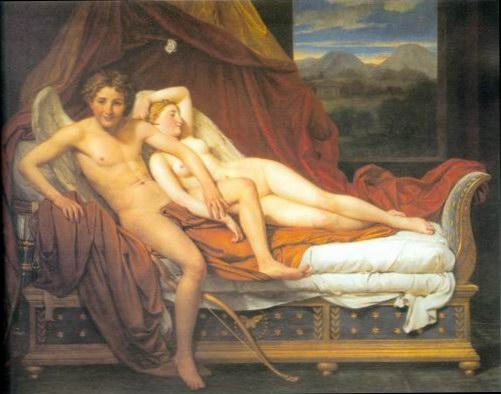
In Roman mythology Psyche (Greek equivalent: Yuch) is the goddess of the soul, the wife of Cupid (Greek equivalent: Eros), the god of love. Psyche started out as a mortal princess. She was the daughter of an anonymous king and his queen. Psyche had two elder sisters. All three sisters were beautiful, but Psyche was the fairest. For her matchless beauty, she was considered as a new Goddess of Love, and as her fame increased, many men came from distant land to witness her for once.

psyche-looking-at-sleeping-cupid
Psyche earned the ire of Venus (Greek equivalent: Aphrodite), the goddess of love and beauty when people diverted their worship from the goddess to the mortal. Venus commanded Cupid, his son, to shoot her with one of his magical arrows to make her fall badly in love with the first man she saw. But the Parcae (Greek equivalent: Moirai ; Fates) decreed otherwise, just as Cupid was about to shoot the arrow at her, he stumbled by her beauty and accidentally pricked himself with the arrow. As a consequence, he fell madly in love with Psyche and carried her away to his secluded palace. However Cupid hid his true identity, and commanded her never to look upon his face. Fearing the fact that his disloyalty might be disclosed to his mother, Cupid visited Psyche only by night unseen and unrecognised. He made her promise that she would never look at him. Although Cupid had forbidden her never to look upon his face, one night, out of curiosity, Psyche lit a lamp and looked upon him while he was sleeping. Psyche got so excited to discover Cupid as her husband that her body started to shiver. When she bent her body to kiss him, a drop of oil spilt from the lamp on the naked body of Cupid and awakened him. Cupid became very angry at the disobedience of Psyche and abandoned her. Psyche found herself alone in the midst of darkness, the whole palace got vanished in the thin air just after Cupid left the scene.

Psyche was devastated when Cupid left her. Subsequently, the brokenhearted young woman decided to go to Venus and beg before her for her blessing on the marriage. Venus, however, saw this as her opportunity to take her revenge. Venus told Psyche that she would consider her worthy of her son if she was able to complete three tasks. Then Venus beat her fiercely. Cupid saw and heard everything standing from distance.

Psyche’s first task was to spend the night in a room filled with mixed grains and to have them all sorted and bagged by daybreak. Realising the impossibility of the task, Psyche started weeping. Watching her misery an army of ants took pity on her and came forward to help her with the task. Because of their helping hands Psyche was able to finish the task in advance of the deadline. As a reward of her success, Venus beat Psyche again like the previous day.

The following day she was given a far more impossible task. Her mission was to bring back the Golden Fleece belonging to a magical ram. The ram was extremely ferocious and already killed several heroes who tried to acquire his fleece. She was Terrified that she also would be crushed by the vicious creature. When she was about to give up her faith on her task’s materialisation, a mermaid took pity on her. Psyche worked according to her advice and managed to collect the fleece. She presented the fleece to Venus. That day Venus mocked at psyche very rudely.

The third task was utterly impossible. Venus gave Psyche a crystal jar to fetch water from the river Styx. That river was guarded by a band of dragons. When Psyche reached there she realised that this task cannot be undertaken by her. When Psyche was about to give up her faith on the task, Jupiter’s (also Jove; Greek equivalent: Zeus) eagle showed up in the sky. The eagle was aware of Cupid and Psyche’s story. So, he took the jar from Psyche’s hand and filled it with Stygian water.

When Psyche returned with the water in the jar, Aphrodite thought she must be a clever and wicked witch, and gave her yet another task. It was Psyche's last and most frightening challenge. The test was to descend into the underworld, the kingdom of the dead, and to return with the beauty box from Proserpina (Greek equivalent: Persephone), the goddess of the dead (goddess of the underworld) and the fertility of the earth. This task was her longest and hardest. Even Venus could realise that this time Psyche would surely die. When Psyche set out for her journey into the underworld, Cupid secretly followed her. He knew very well that this time she was walking towards death. When she was about to enter the underworld, Cupid, staying out of sight, instructed her how to collect the beauty box from Proserpina. Psyche could not recognise Cupid’s voice. However, she worked according to his advice and was able to get the box. At the time of returning, she thought that if Venus keeps her promise, she would be able to meet Cupid just after completion of this task. Thus, she thought that she should prepare herself to face that moment of truth. Then, with a view to increase her beauty a bit more, she decided to use a tiny touch of the beauty contained in the box. But as she opened the box, a black cloud covered her. What she released from that box was not beauty but Stygian sleep. She fell to the ground and lay like a corpse without sense or motion. She was supposed to sleep forever, but Cupid came forward and rescued her. He shut the cloud of sleep up again in the box and awakened Psyche with the light prick of one of his arrows.

Accepting the reality that he truly loved Psyche, he flew to the heaven and begged to the supreme god Jupiter to consider his case. So Jupiter, who had been defiled by Eros so many times, found on this occasion the opportunity to teach Cupid a lesson. But instead, he assured Cupid that his prayer would be granted. Zeus then called a council of the gods. There, in front of everybody, Jupiter requested Venus to forgive psyche. Venus could not refuse that request. She blessed Psyche wholeheartedly. Then upon Minerva’s (Greek equivalent: Athena, also: Athene) advice Jupiter decided to make psyche the last goddess of Olympia. A marriage ceremony was arranged to legitimise their relationship.

Thus after many trials Psyche and Cupid were united. And in due time they had a daughter born to them whose name was Pleasure/Volupta/ Hedone.

Cupid_and_Psyche_by_French_painter_Jacques_Louis_David
Psyche_Statue_by-W_VHoyer
The_abduction_of_Psyche_By_Bouguereau
Cupid-and-Psyche

The fable of Cupid and Psyche is usually considered allegorical. The Greek name for a butterfly is Psyche, and the same word means the soul. There is no illustration of the immortality of the soul so striking and beautiful as the butterfly, bursting on brilliant wings from the tomb in which it has lain, after a dull, grovelling, caterpillar existence, to flutter in the blaze of day and feed on the most fragrant and delicate productions of the spring. Psyche, then, is the human soul, which is purified by sufferings and misfortunes, and is thus prepared for the enjoyment of true and pure happiness.

In works of ancient mosaics Psyche is represented as a maiden with the wings of a butterfly, along with Cupid. Sometimes a pair of Psyches is portrayed; the second is probably their daughter Pleasure.

The story of Psyche and Cupid has been the interesting subject of scrutiny for numerous literary artists. The 17th century English poet John Milton, for example, alludes to the story of Cupid and Psyche in the conclusion of his Comus:
"Celestial Cupid, her famed son, advanced,
Holds his dear Psyche sweet entranced,
After her wandering labours long,
Till free consent the gods among
Make her his eternal bride;
And from her fair unspotted side
Two blissful twins are to be born,
Youth and Joy; so Jove hath sworn."
The English Romantic poet John Keats alludes to the story of Cupid and Psyche in his Ode to Psyche:
"O latest born and loveliest vision far
Of all Olympus' faded hierarchy!
Fairer than Phœbe's sapphire-regioned star
Or Vesper, amorous glow-worm of the sky;
Fairer than these, though temple thou hast none,
Nor altar heaped with flowers;
Nor virgin choir to make delicious moan
Upon the midnight hours;
No voice, no lute, no pipe, no incense sweet,
From chain-swung censer teeming;
No shrine, no grove, no oracle, no heat
Of pale-mouthed prophet dreaming."

References

Khan, Farhad. An Encyclopedia of Classical Literature. Dhaka: Protik, 1996.

Bulfinch, Thomas. Bulfinch's Mythology: The Age of Fable, The Age of Chivalry, Legends of
Charlemagne. New York: Random House, 1934.

“Psyche.” Greek Mythology Link. 1997. Carlos Parada and Maicar Förlag. 30 March 2010
< http://homepage.mac.com/cparada/GML/Psyche.html >.

March 17, 2010

Introduction

william-shakespeare
No writer in the history of world literature holds such a unique position as the Elizabethan playwright William Shakespeare does. Shakespeare's works are highly remarkable for their graceful style and universally celebrated for their comprehensive understanding of human condition. Shakespearean works exhibit the power of literature to transport the audience into a magnificent word of mystery and fantasy. Shakespeare is definitely the unchallengeable master of romantic literature. His writings have proven that it is still possible to explore human life without presenting it realistically. He was quite aware of the classical formulas of writing, but opted to write in his individual style. His novel dramatic technique thought to have paved the way for the 20th century romantic movement. Following his style a number of great romantic writers such as Wordsworth, Shelley, Keats, Coleridge shaped their poetic career. His works of art have been entertaining for the last few centuries and still continue to amaze us with their artistic and universal appeal. His friend and fellow dramatist Ben Jonson could recognise his brilliance and wrote in praise of him:

"He was not of an age, but for all time!"

read-quotation-by-shakespeare
William Shakespeare is the first significant writer in English literature whose dramatic skill transformed ordinary human character and action into unforgettable piece of art. Such a writer cannot definitely stay out of criticism. As a result, we have a number of rumours about him that sometimes baffle us. One such tradition strangely declares that the Shakespearean dramas were not written by Shakespeare himself. According to this claim these plays were originally written by Francis Bacon, or the Earl of Oxford, or a syndicate of playwrights using the name of Shakespeare as pen name. Even sometimes it is doubted whether there exited a real person named Shakespeare. But such theories lack sound historical evidence.

Shakespeare’s writing style has been a subject of scrutiny for a number of critics. Many critics believe that some of his writings lack originality. The dramatist borrowed his raw materials largely from classical legend, history, and biography;Italian tales; English and Scottish chronicles; even older plays and folk tales. But all these old works were brilliantly transformed by a freshness of presentation. Mixing of different plots never made his plays incoherent. These dramatic reconstructions have become the most original creations of Shakespeare. The patterns of his plots are sometimes complex but always clearly woven. His characters are true to life and well developed. In his plays he mixed tragedy and comedy since they are mixed in human life.

Life

Surprisingly, Shakespeare is the single most writer of his age to have such a rich amount of information about his life. But there are truly no authentic source to write an accurate biography for Shakespeare. Most of his biographies are written on the basis of assumptions.

Early Life

William Shakespeare (also spelled Shakspere, Shaksper, Shaxper, and Shake-speare, due to the fact that spelling in the Elizabethan times was not fixed and absolute) was born on or about April 23, 1564 in the village of Stratford-on-Avon in the country of Warwickshire. His birth is assumed to have occurred at the family house on Henley Street.The third of eight children, William Shakespeare was the eldest. His father John Shakespeare was a farmer’s son from the neighbouring village of Stratford. He came to Stratford about 1531 and began to prosper as a trader in corn, meat, leather, and other agricultural products. His mother Mary Arden was from a family much above her husband’s social status. She was the daughter of a prosperous farmer, descended from an old family of mixed Anglo-Saxon and Norman blood. It is generally believed neither of the parents could read nor write.

shakespear's-house

Little is known about Shakespeare’s formal education. The young Shakespeare probably attended the King Edward VI Grammar School in central Stratford, which educated the sons of Stratford citizens. The curriculum of that school was largely based on the study of Latin grammar and literature. Shakespeare’s writings evince that he was greatly influenced by the classical Latin writers like Ovid as well as other Latin works. But his real his real talent were greatly influenced by the men and natural surroundings of his village. He grew up in the beautiful village of Stratford with sights and scenery that could stir up anyone’s creative side. Many of his literary works reflect the beauty and splendour of his birthplace.

read-quick-facts-on-shakespeare
When Shakespeare turned 14 years old, his father lost his property and fell into debt. Shakespeare probably left school to help to support his family. But it is not exactly clear what occupation did he follow for the next eight years. However, a potentially reliable claim is that during his father’s financial decline Shakespeare had been a schoolmaster in the country.

At the age of 18 he married 26 year old Anne Hathaway (on November 27?, 1582), the daughter of a Warwickshire farmer. Now it is believed that young Shakespeare might have been involved in a love affair with Anne.There appears to have been some haste in arranging the ceremony, presumably because Anne was 3 months pregnant. The birth of a daughter six months after the marriage also provides some explanation for that quick arrangement.

anne-hathaway-cottage

After his marriage, Shakespeare left few traces in the historical record until he appeared on the London theatrical scene. Indeed, the late 1580s (years between 1585 and 1592) are known as Shakespeare’s “lost years” because no evidence has survived to show exactly where he was or why he left Stratford for London. On May 26, 1583, Shakespeare’s first child, Susanna, was baptised at Stratford. Twin children, a son, Hamnet, and a daughter, Judith, were baptised on February 2, 1585. Hamnet died in 1596. Sometime after the birth of the twins, Shakespeare apparently left Stratford, but no records have discoverd to reveal his activity between their birth and his presence in London in 1592, when he was already at work in the theatre. An unsubstantiated report claims Shakespeare left Stratford after he was caught while stealing deer in the park of Sir Thomas Lucy, a local justice of the peace. Another theory has him leaving for London with a theatre troupe that had performed in Stratford in 1587.

Life in London

Shakespeare’s initial life in London began as a humble one. Tradition claims that he used to hold the horses at the door of a theatre-house, where the gentlemen of rank and fashion came to enjoy performance on horseback. He got interested in the theatre from the very beginning and from outside he found his way to the inside of the theatre. He became an actor in minor parts until he gradually worked his way to a better position. Subsequently he was entrusted with the task of repairing the old plays, and in this task he received his apprenticeship in the dramatist’s craft. From 1592 his individual dramatic career began and gifted the world thirty seven plays, which are without question the richest treasure in English literature.

The theatre served Shakespeare’s financial needs very well. In 1597 he bought New Place, a substantial three-story house in Stratford. With the opening of the splendid Globe Theatre in 1599, Shakespeare’s fortunes increased and in 1602 he bought additional property: 43 hectares (107 acres) of arable land and 8 hectares (20 acres) of pasture north of the town of Stratford and, later that year, a cottage facing the garden at New Place. In 1605 he bought more property in a neighboring village. His financial activities can be traced, and his final investment is the purchase of a house in the Blackfriars district of London in 1613.

Last Years

holy-trinity-church
After about 1608 Shakespeare began to write fewer plays. For most of his working life he wrote at least two plays a year; by 1608 he had slowed usually to one a year, even though the acting company continued to enjoy great success. In 1611 Shakespeare retired from London theatre and returned to his village, where he had established his family and became a prominent citizen. He lived there still his demise. He died on April 23, 1616 at the age of 52. He also died on his birthday, if the tradition that he was born on April 23 is correct. He was married to Hathaway until his death and was survived by his two daughters, Susanna and Judith. Susanna married Dr. John Hall, a doctor with a thriving practice in Stratford, in 1607. His younger daughter, Judith, married a Stratford winemaker, Thomas Quiney, in 1616. Shakespeare’s wife, Anne, died on August 6, 1623. Soon after her death, Susanna and John Hall moved into New Place, where they lived until their deaths, his in 1635 and hers in 1649. Their daughter, Elizabeth Hall, died childless in 1670. Judith Quiney had three sons, but none lived long enough to produce heirs, and she died in 1662. Thus, by 1670, the line of Shakespeare’s descendants had reached its end. There are no direct descendants of the playwright alive today.

Shakespeare was buried in the chancel of Holy Trinity Church in Stratford-upon-Avon. He was granted the honour of burial in the chancel not on account of his fame as a playwright but for purchasing a share of the tithe of the church for £440. A monument placed by his family on the wall nearest his grave features a bust of him posed in the act of writing. Each year on his claimed birthday, a new quill pen is placed in the writing hand of the bust. It is assumed Shakespeare himself wrote the epitaph on his tombstone:

Good friend, for Jesus' sake forbear
To dig the dust enclosèd here;
Bleste be the man that spares these stones,
And cursed be he that moves my bones.

Shakespeare’s Plays

So far as is known Shakespeare had no hand in the publication of any of his works. Only 16 plays were published before his death. Almost all the plays of Shakespeare were printed posthumously by his fellow actors, John Heminges and Henry Condell in a volume called First Folio in 1623. They were published from Shakespeare’s original manuscripts, though several of them had been obtained from earlier published Quartos. The traditional division of his plays into tragedies, comedies, and histories follows the logic of the First Folio. It is at this point that stage directions, punctuation and act divisions enter his plays, setting the trend for further future editorial decisions. Modern criticism has also labelled some of his plays “problem plays” or tragi-comedies, as they elude easy categorisation, or perhaps purposefully break generic conventions. The term “romances” has also been preferred for the later comedies.

first-folio-cover
The exact date of composition of Shakespearean plays is a highly disputable issue. By using evidences of style, versification, and general tone it has been possible to arrange the plays in their chronological order. On the whole, there is a unanimity among the critics about this order. The dramatic career of Shakespeare has been divided into four sharply-defined periods and the plays of each period bear certain family resemblances.

(i) The First Period: This period covers the years 1588-1596. This was a period of apprenticeship and was largely experimental. The works of this period are immature and the style is often crude and artificial. The plays written in period are:

Titus Andronicus; Henry VI (three parts); Love’s Labour’s Lost; Comedy of Errors; Two Gentlemen of Verona; Richard III; Romeo and Juliet.

(ii) The Second Period: This period covers the years 1596-1600. It is the period of great comedies and chronicle plays. The plays written in this period shows rapid growth of his genius. These plays reflect a deeper understanding of human life and human nature. This is the period when he abandoned rime and used blank verse. The plays of this period are:

King John; The Merchant of Venice; Henry IV (Part I & Part II); Henry V; The Taming of the Shrew; The Merry Wives of Windsor; Much Ado About Nothing; As You Like It; and Twelfth Night.

(iii) The Third Period: This period includes the years 1601-1607. It is the period of the great tragedies, and of the sombre or bitter comedies. It is considered the supreme phase of Shakespeare’s literary career. This is the time when Shakespeare wrote his greatest masterpieces. At this stage his attention was largely confined within the darker sides of human nature. The plays of this period are:

Julius Caesar; Hamlet; All’s Well That Ends Well; Measure for Measure; Troilus and Cressida; Othello; King Lear; Macbeth; Antony and Cleopatra; Coriolanus; and Timon of Athens.

(iv) The Fourth Period: This period covers the years 1608-1612. It is the period of the later comedies or dramatic romances. The plays of this period reveals the decline of Shakespeare’s dramatic powers since they lack careful characterisation, plot construction, and versification. During this period Shakespeare changed his temper from bitter and gloomy to serene and peaceful. Beauty and calmness, forgiveness and reconciliation are the main noted of the plays of this period, which have been called “romances”. he plays written in period are:

Pericles (1608); Cymbeline (1609); The Winter’s Tale (1610-11); The Tempest (1611); Henry VIII (unfinished).

References

Long, William J. English Literature: Its History and its Significance for the Life of the English
Speaking World. Delhi:AITBS, 2002

Watt, Homer A. and William W. Watt. A Handbook of English Literature. New York: Barnes &
Noble, 1946

Evans, Ifor. A Short History of English Literature. London: Penguin Books, 1976

March 11, 2010

Imagery

The intensity of any literary work largely depends on powerful imagination. It also depends on the effective execution of that very imagination in the pages of a literary work. Therefore, to visualise his/her imagination the poet/writer often employs various literary devices. The most effective and compelling of those is the use of imagery (a figure of speech). Imagery is used in literary works to refer to the ways the writers compose mental images in words. It signifies all the sensory perceptions used in a literary work, whether by literal description, allusion, simile, or metaphor. Imagery is not limited to visual imagery; it also includes auditory (sound), tactile (touch), thermal (heat and cold), olfactory (smell), gustatory (taste), and kinesthetic sensation (movement). Imagery engages the reader’s imagination through wonderful descriptions or illustrations that vividly portray the reality of a particular moment. A literary work with effective imagery gives the reader a clear mental picture of what is happening and enhance what the writer is trying to convey to the reader. The main functions of imagery can be summarised in the following manner:
  • Imagery is used to concretise an abstract or inner state of mind.
  • Generally a poet’s/ writer’s imagery takes the form of similes and metaphors which are used either for effective communication of thought or decorative purposes.
  • Sometimes the poet/writer bases his imagery on literary descriptions.
  • It is not merely used to signify descriptions of visible objects and scenes.
  • Imagery is used to signify all the objects and qualities of sense perception.
  • It enables the poet/writer to draw/ create pictures in words.

March 4, 2010

Introduction

The Behaviourist Theory (also known Empiricism, Behaviourism, Behavioural Theory, Stimulus-response Theory) stands among the major theoretical perspectives within the field of first language acquisition. It began as a reaction against the introspective psychology of the late 19th and early 20th century and dominated the study of learning throughout the first half of the twentieth century. Although its ascendancy was blurred by the emergence of the Innate Theory in the mid 20th century, still today much language learning programmes firmly stands on the foundation laid by the Behaviourist Theory.

Theoretical Assumptions

The theoretical assumptions underlying the Behaviourist Theory are as follows:
  • Language learning is a habit formation resembling the formation of other habits. In other words, Language is learned in the way in which other habits are learned.
  • Language learning is nothing more than the acquisition of new behaviour or knowledge. It takes place when experience or practice causes a change in a person's knowledge or behaviour.
  • Language learning is an external event because it involves an observable change in behaviour brought about by the stimuli coming from the environment. It does not involve any unobservable change in mental knowledge. All behaviours can be explained without the need to consider internal mental states or consciousness.
  • Only human beings have the capacity for language learning. They acquire a language as discrete units of habits, independently trained, not as an integrated system.

Background of the Theory

The behaviourist school of thought ran concurrent with the psychoanalysis movement in psychology in the 20th century. The Behaviourist Theory was first introduced in 1913 by the American psychologist John B. Watson. Watson is credited by some with coining the term "behaviourism". Watson’s view was largely influenced by the research of the Russian physiologist Ivan P. Pavlov during the early 1900s. The most influential version of this theory is put forward by B. F. Skinner in 1959. His version of Behaviourism is best known as Radical Behaviourism. Skinner, sought to give ethical grounding to behaviourism, relating it to pragmatism.

Types of Behavioural Learning

Experiments by the behaviourists identify conditioning as a universal learning process. Conditionings are primarily of two types, each yielding a different behavioural pattern:

1. Classical conditioning: This conditioning was first described by the Russian physiologist Ivan Pavlov, in 1903 through his experiment on dogs. The general idea of Pavlov’s experiment is this: Pavlov presented dogs with food to examine their salivary response. He rang a bell just before serving the food. At first, the dogs did not salivate until the food is served. However, when the bell was rung at repeated feedings, the sound of bell alone caused the dogs to salivate.

pavlov's-classical- conditioning

Thus in classical conditioning an unconditioned stimulus (food) is paired with a conditioned stimulus (bell). When they repeatedly occur in pair, the conditioned stimulus acquires the capacity to produce a conditioned response (salivation). Subsequently, the conditioned stimulus alone can produce a conditioned response.

Subsequently, it was studied in infants by John B. Watson. Like Pavlov, he was originally involved in animal research but later became involved in the study of human behaviour. Watson believed that humans are born with a few reflexes and the emotional reactions of love and rage. All other behaviour is established through stimulus-response associations through conditioning.

Watson demonstrated classical conditioning in an experiment involving a young child (Albert) and a white rat. Originally, Albert was unafraid of the rat; but Watson created a sudden loud noise whenever Albert touched the rat. Because Albert was frightened by the loud noise, he soon became conditioned to fear and avoid the rat. The fear was generalised to other small animals. Watson then extinguished the fear by presenting the rat without the loud noise. Some accounts of the study suggest that the conditioned fear was more powerful and permanent than it really was.

2. Instrumental or Operant Conditioning: Expanding on Watson’s basic stimulus-response model, Skinner developed a more comprehensive view of conditioning, known as operant conditioning. Skinner’s model was based on the premise that effective language behaviour consists of producing responses (behaviours) to the correct stimuli (situation). When a response is followed by a reinforcer (reward) then it is conditioned to occur again. Thus operant conditioning was used by Skinner to describe the effects of the consequences of a particular behaviour on the future occurrence of the behaviour. Reinforcement and punishment are the core ideas of operant conditioning:

Reinforcement: A reinforcer is a stimulus (encouraging activity) that increases the frequency/occurrence of a response it follows. The act of following a response with a reinforcer is called reinforcement. Reinforcement (prize) can be classified into the following types:

(i) Positive Reinforcement: Positive reinforcement is the encouragement of a desired response (behaviour) by a pleasant stimulus. It increases the probability of the reoccurrence of the same response to the same situation. For example: If the child produces an alternative which is appropriate to the situation, the mother will reward him/her with some sign of approval (such as smiles, hugs, or food). This approval or reward will encourage him to repeat the same response to the same situation.

(ii) Negative Reinforcement: Negative reinforcement is the discouragement of an undesired response (behaviour) by an unpleasant stimulus. It decreases the probability of the reoccurrence of the same response to the same situation. For example: If the child produces an utterance which is inappropriate to the situation, he/she will not be rewarded. Consequently, the child will not repeat the same response to the same situation.

Punishment: Punishment is used to erase undesirable behaviours by presenting a distressing stimulus when the behaviour occurs. Punishment can be classified into the following types:

(i) Positive Punishment: An undesirable stimulus is received after a behaviour occurs. For example, if the learner fails to follow the class then he will be given detention.
(ii) Negative Punishment: A desirable stimulus is lost or removed after a behaviour occurs. For example, if the learner fails to follow the class rules then he will not be given any recess hour.

Thus, it is quite visible that the Behaviourist Theory (as propounded by Skinner) is represented as a “stimulus – response – reinforcement” chain. For better understanding, this chain can be demonstrated in the following illustration:


stimulus-response-reinforce-chain


The Behaviourist Theory explains two major aspects. It firstly explains how the child produces speech. It secondly explains how he/she understands speech. Positive and negative reinforcement contain various adult utterances which function as discriminating stimuli for the production of the child’s responses (behaviours). When the child hears these adult utterances he/she tries to imitate them to produce his/her speech. The child earns the ability to understand a speech when he/she becomes able to produce an utterance which is appropriate to the situation. Reinforcement can come from different sources. The mother is the primary source of reinforcement because she has to take care of the child almost all the time. The people around him/her can also provide reinforcement.

Drawbacks

Although sound in many ways, the theory is not free from limitations. The shortcomings of this theory are as follows:

Firstly, the Behaviourist Theory completely ignores the inborn aspect of human knowledge.
Secondly, the theory puts over-emphasis on the role of imitation and ignores completely the creativity of the child, making him/her somewhat passive viewer than actor in the process of language acquisition.
Thirdly, the Behaviorist Theory seems to be somewhat mechanical in nature, since the child is considered a passive object.
Fourthly, it cannot develop the child’s problem-solving skills. The child may find himself/herself in a situation where the stimulus to the correct response does not occur. In such cases, the child won’t be able to respond.
Fifthly, it fails to explain how the child understands utterances he/she has never heard before, or he/she produces new and unique utterances.
Finally, the Behaviourist Theory cannot explain how the child proceeds in his/her journey of language acquisition at such a young age.

Conclusion

The Behaviourist Theory came under fierce attack when Chomsky proposed his Innate Theory in 1959. Chomsky’s theory strongly proved that the child is not a tabula rasa; rather he is born with an innate capability to learn language. Nevertheless, along with all of its limitations, the Behaviourist Theory was able to govern the direction of the psychological explanation of language acquisition quite productively. After its emergence, this theory was passively accepted by the influential Bloomfieldian structuralist school of linguistics and produced some well-known models of foreign language teaching, most notably, the Audio Lingual Method. For many years, the concepts from the Behaviourist Theory formed the basis of most of the learning theory applied in child rearing and in classrooms. Parents and teachers still find that, in many instances, individuals do learn when provided with the appropriate blend of stimulus, reinforcement, and punishments. Especially with small children and simpler tasks, behaviourist principles are often effective. Thus, the contribution of the Behaviourist Theory as an explanation of child language development cannot be overlooked altogether.

References

“Behaviorism.” Funderstanding. 1998-2001. Funderstanding. 20 Sep 2008 < http://www.funder-
standing.com/behaviorism.cfm >.

“Behaviorist Learning Theory.” Innovative Learning. 2008. InnovativeLearning.com. 20 September 2008
< http://www.innovativelearning.com/educational_psychology/behaviorism/index.html>.

“Behaviorist Theories of Learning.” SIL International. 1999.SIL International. 22 August 2008
< http://www.silinternational.org/>.

“Classical Conditioning (Pavlov) .” Learning –Theories.com. 2008. Learning Theories.
< http://www.learning-theories.com/classical-conditioning-pavlov.html >.

“Instructional Design & Learning Theory.” University of Saskatchewan. 1994-2008.
University of Saskatchewan.22 August 2008< http://www.usask.ca/education/coursework/
802papers/mergel/brenda.htm>.

“Learning Theories/Behavioralist Theories.” Wikipedia. 2008. Wikimedia Foundation, Inc.
20 September 2008 <http://en.wikibooks.org/wiki/Learning_Theories/Behavioralist_Theories>.

February 14, 2010

INTRODUCTION

The formulation of a new type of syllabus became inevitable when dissatisfaction was targeted to the Grammatical Syllabus. Even though the Grammatical Syllabus has been used with considerable success over a long period of time, many modern linguists have come to see grammar as the wrong organising principle for a syllabus, since effective language use cannot be ensured unless it is contextualised, involving ample social interaction. Therefore, the most commonly proposed alternative is to take situational needs as the starting point and thereby to construct a Situational Syllabus to replace the Grammatical Syllabus. The Situational Syllabus did a lot to fill the vacuum that was caused by the drawbacks of the Grammatical Syllabus. The Situational Syllabus, however, is not as firmly based as the Grammatical Syllabus on any well-formulated view of language. Nevertheless, like its precursor the Grammatical Syllabus, it has also proven its importance as being the most extensively used component for the Multi Syllabuses.

MAJOR CHARACTERISTICS

The major characteristics of the Situational Syllabus are as follows:

Theoretical Bases: The central argument for the Situational Syllabus is that language is always used in a social context and cannot be fully understood without reference to the contextual settings. According to Wilkins, the Situational Syllabus is constructed on the analyses of situations and behaviours. The Situational analysis can enable the syllabus designers to predict in what situations the learners are likely to use the language and teach accordingly. The Behavioural analysis aims to consider the likely behaviours or activities that the learners may conduct in different situations.

Contents/Selecting & Sequencing the Contents: In the Situational Syllabus, the content is specified and ordered in non-linguistic terms (i.e. excluding grammatical items, vocabulary topics, or functions). The content of language teaching is a collection of real or imaginary situations in which language occurs or is used. It (the content) often takes the form of dialogues and conversations. The learners are expected to practice the dialogues and memorise useful expressions and patterns. The grammar and the vocabulary derived from the situations are not themselves the driving force behind the selection. However, the grammar and the vocabulary are also taken into account when the language forms in situations are selected since these two components receive primary attention in almost all types of syllabus design and development. Thus the main components of the Situational Syllabus can be analysed in the following order:
  1. a list of language situations, and
  2. description of the grammatical and lexical items of each of these situations.
Objectives: Situations are the organizing principle of the situational syllabus. A situation usually involves some kinds of transactions in a specific setting. The language occurring in the situation involves a number of a probable segment of discourse/dialogue. The primary purpose of a situational language teaching syllabus is, thus to teach the language that occurs in the situations. Examples of such probable situations include:
  • At the hotel,
  • At the travel agent,
  • At the post office,
  • At the restaurant,
  • At the garage,
  • At the airport,
  • At the shopping mall,
  • At school, and so on.
Procedure: In the initial stage of teaching, the teacher has to analyse the probable linguistic situations in which the learners may use the language. Next, he has to analyse the probable behaviours/ activities that the learners may carry out in different situations. In order to conduct the behavioural analysis, the teacher must rely upon a set of parameters for describing the significant features of situations. These include:
  • the physical context in which the language event occurs,
  • the channel of communication (i.e. spoken or written),
  • whether the language activity is productive or receptive,
  • the number and the character of the participants,
  • the relationship between the participants, and
  • the field of activity within which the language event takes place.

ADVANTAGES

The Situational Syllabus offers guidelines for organising language teaching materials on a relatively limited scope, yet it has proven to be beneficial in several ways:
  1. Wilkins considers this type of syllabus more efficient and more motivating than the Grammatical Syllabus because it hinges around practical needs rather than abstract analysis.
  2. It is a learner-centred syllabus since it takes account of the learner and his needs.
  3. It enables the learners to behave appropriately in various social contexts.
  4. It pays more attention to learners’ speaking ability in contrast to the Grammatical Syllabus.

WEAKNESSES

Even though the Situational Syllabus is widely used as a replacement for the Grammatical Syllabus to organise language teaching materials, there is still strong criticism against this model:
  1. The main disadvantage of the Situational Syllabus is that it is less appropriate for the students of general English since it tries to teach language in the context of some specific linguistic situations, which cannot be considered as an all-encompassing yardstick for fulfilling the learners’ general language needs. That is because it is difficult to guarantee that one specific situation will be useful in another.
  2. Although some situations have a predictable script, unanticipated things can happen in any situation, requiring a change of script or topic. Wilkins points out, that a physical situational setting such as “At the Post Office” or “In a Restaurant” does not necessarily predict the language forms that will be used. One may go into a restaurant not to order a meal but to ask directions to a nearby museum or to change money for a telephone call. While certain language functions will most likely occur in certain situational settings, the physical setting cannot really predict language use. It depends on who the students are and where they are learning. Thus determining the appropriate list of situations for a general class is difficult.
  3. Grammar is dealt with incidentally, so the Situational Syllabus may result in gaps in learners’ grammatical knowledge.
  4. The Situational Syllabus does not provide us with clearly defined criteria for the sequencing of teaching items. Little is known about the language used in different situations, so the selection of teaching items is typically based on intuition.
  5. The Situational Syllabus is probably most appropriate for short-term special-purpose courses: giving prospective tourists survival skills or preparing service personnel, such as waiters or waitresses, to deal with routine requests or firefighters to handle emergency situations. It has limited potential for the language learner interested in acquiring global language proficiency. For this reason, it is generally used as the component of a Multi Syllabus rather than as the central organising principle for a general language syllabus design.

Conclusion

In the verdict, it can be remarked that The Situational Syllabus is useful only in certain circumstances. It does not have the potentials to offer a comprehensive solution to the problems of language learning for the students of general English. Yet, its contribution to syllabus design cannot be denied altogether, since it is the first syllabus type to consider the situational needs as important criteria for language learning, which are no less important than the knowledge of grammar.

The Situational Syllabus

References

Barman, Dr. Binoy, Zakia Sultana, and Bijoy Lal Basu. ELT: Theory and Practice. Dhaka:
FBC, 2006. 24-38.

“EFL Syllabus Design.” Finchpark. 2008. Dr. Andrew Finch. 22 August 2008
<http://www.finchpark.com/afe/tbsyll.htm>.

“Grammatical, Situational and Notional Syllabuses.” Eric Education Resources Information Center.
2008. ERIC. 22 August 2008<http://eric.ed.gov/>.

Harmer, Jeremy. The Practice of English Language Teaching. 3rd ed.
England: Longman-Pearson,2001. 295.

“How to Develop a Situational-topical Syllabus.” SIL International. 1999.SIL International.
22 August 2008 < http://www.silinternational.org/>.

“Language Acquisition and Syllabus Design: The Need for a Broad Perspective.”ADFL Bulletin.
1984. Association of Departments of Foreign Languages.22 August 2008
<http://web2.adfl.org/adfl/bulletin/V15N3/15300I.htm>.

“Travel English Dialogs Based on a Situational Syllabus.” Takamatsu. 2008.
The Regents of Takamatsu University. 22 August 2008
< http://www.takamatsu-u.ac.jp/nlibrary/kiyo/no34/no34ikeuchi.pdf>.

Random Articles