🔍 Search Best Services

Popular Searches:

January 24, 2013

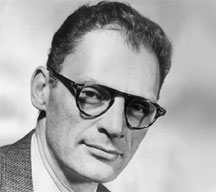
Arthur Miller

Arthur Miller
A leading 20th century American playwright and screenwriter

  • Full Name: Arthur Asher Miller
  • Birth: October 17, 1915
  • Death: February 10, 2005
  • Place of Birth: Harlem, New York City, USA
  • Place of Death: Roxbury, Connecticut, USA
  • Cause of death: Heart Failure
  • Buried at: Roxbury Center Cemetery, Roxbury, Connecticut
  • Religion: Jewish
  • Father: Isidore Miller
  • Mother: Augusta Barnett
  • Siblings: One older brother:  Matthew Kermit and a younger sister:  Joan Copeland
  • Marriage: Married thrice: Mary Grace Slattery  in August 5, 1940, Marilyn Monroe in June 29, 1956, Inge Morath in February 17, 1962
  • Number of Children:  He had four children, Jane and Robert A. Miller with Slattery and Rebecca Miller and Daniel with Morath.
  • Education: BA Journalism, University of Michigan (1938)
  • Known for: his awareness of portraying social realities of life
  • Criticised for: his scandalous life story
  • Influences: Henrik Ibsen
  • Influenced: NA

Quote:

I think the tragic feeling is invoked in us when we are in the presence of a character who is ready to lay down his life, if need be, to secure one thing -- his sense of personal dignity.
Arthur Miller, "Tragedy and the Common Man"

Major Themes:

  • American dream/ self-delusion
  • Social and economic pressure
  • Value of human life
  • Illusion versus reality
  • Vengeance
  • The mentality of working class Americans
  • Responsibility to others
  • Generation gaps: old people vs. young people
  • Vulnerability of human existence in the modern era

Notable Works:

  • Honors at Dawn (1936)
  • The Man Who Had All the Luck (1944)
  • All My Sons (1947)
  • Death of a Salesman (1949)
  • The Crucible (1953)
  • A Memory of Two Mondays (1955)
  • A View from the Bridge (1955)
  • After the Fall (1964)
  • Incident at Vichy (1965)
  • The Price (1968)
  • The Creation of the World and Other Business (1972)
  • The Archbishop's Ceiling (1977)
  • The American Clock (1981)
  • Elegy For a Lady (1982)
  • Some Kind of Love Story (1982)
  • Danger: Memory!: Two Plays (I Can't Remember Anything and Clara) (1986)
  • The Ride Down Mt. Morgan (1991)
  • The Last Yankee (1993)
  • Broken Glass (1994)
  • Mr. Peters' Connections (1998)
  • Resurrection Blues (2004)

Did You Know?

  • Arthur Miller’s father, Isidore Miller was a women's clothing manufacturer.
  • Isidore Miller was an illiterate Jewish immigrant from Poland.
  • Miller's family lost almost everything in the Stock Market Crash of 1929.
  • After high school graduation Miller worked a few odd jobs in order to save money for his education at University of Michigan.
  • Miller's debut Broadway play, The Man Who Had All the Luck (1944), was a great failure and closed after only four performances.
  • All My Sons (1947) became Miller's first success on Broadway and earned him his first Tony Award.
  • Miller alleged to be a life-long atheist.
  • Among Miller's most prestigious awards, are Emmy Awards, Tony Awards and a Pulitzer Prize for Drama.
  • A View from a Bridge (1955), one of Miller's best one-act plays was modified in 1956 to include two acts.
  • Arthur Miller married three times: Mary Slattery (1940-1956), Marilyn Monroe (1956-1961), and Inge Morath (1962-2002). He had two children with Slattery (Jane and Robert) and two more with Morath (Rebecca and Daniel). He did not have any children with Monroe.
  • The playwright and Monroe divorced less than two years before the famous actress died
  • In 1961, the year Miller and Monroe got divorced, Monroe starred in her last film The Misfits, which was based on the original screenplay by Miller.
  • Miller's daughter Rebecca married Academy Award winning actor Daniel Day-Lewis.
  • Miller's youngest son was born with Down Syndrome.
  • Miller decided to get married for the fourth time with the 34 year old minimalist painter Agnes Barley, but the plan failed as he died of heart failure.
  • Miller is buried with his wife Inge in Roxbury Center Cemetery, Roxbury, Connecticut.  Their grave is marked by an irregular granite upright marker and they each have flat granite foot markers.
  • Death of a Salesman was his first critically accepted play. It was opened on Broadway in 1949. The Play brought him three praiseworthy awards such as, the Pulitzer Prize, the New York Drama Critics' Circle Award and a Tony Award.
  • Miller’s play The Crucible (1953), although concerned with the Salem witchcraft trials, was actually an allegory of contemporary witch hunt plotted by Senator Joseph McCarthy in the early 1950s to blacklist the alleged communists from the government and other areas of American life.
  • Three years after The Crucible, in 1956, he was convicted of contempt of court for not revealing the names of Communist Party members before McCarthy's committee (House of Representatives' Committee on Un-American Activities).
  • Miller wrote the screenplay for the production of a film version of The Crucible (1996).
  • The film version of The Crucible was not as well received as was the play.
  • His last play of note was The Price (1968), a piece about family dynamics.


References
“Arthur Miller.” Microsoft Encarta. DVD-ROM. Redmond: Microsoft, 2005.

“Arthur Miller Biography.” Bio. True Story. 1996–2013. A+E Television Networks, LLC.
25 November 2012
< http://www.biography.com/people/arthur-miller-9408335>.

“Biography of Arthur Miller.” GradeSaver. 1999-2013. GradeSaver LLC. 25 November 2012
< http://www.gradesaver.com/author/arthur-miller/>.

 “Fun Arthur Miller Facts.” Life123. 2013. Life123, Inc. 25 November 2012
< http://www.life123.com/>.

January 12, 2013

Seamus Heaney

Seamus Heaney

Irish poet, essayist, critic, playwright, editor, translator, lecturer and the winner of the Nobel Prize in Literature.
  • Full Name: Seamus Justin Heaney
  • Pseudonym: Incertus   
  • Birth: 13 April 1939
  • Place of Birth: Northeast of Belfast in Northern Ireland
  • Father: Patrick Heaney
  • Mother: Margaret Kathleen Heaney (née McCann)
  • Siblings: two sisters and six brothers
  • Marriage: 1965
  • Spouse: Marie Devlin
  • Number of Children: 03
  • Education: St. Columb's College, Queen's University
  • Known for: his poetry which is noted for its portrayal of beautiful surroundings of Irish rural life as well as for its glimpse into the Irish historical and political events
  • Criticised for: for being an apologist and mythologizer
  • Influences:  T. S. Eliot, Robert Frost, Wilfred Owen, William Butler Yeats, William Shakespeare, Patrick Kavanagh, Derek Mahon, George Byron, Geoffrey Chaucer, Herbert McCabe, John Keats, John Millington Synge, William Wordsworth, John Montague
  • Influenced: Nick Laird, Eavan Boland

Quote:

“Poetry cannot afford to lose its fundamentally self-delighting inventiveness, its joy in being a process of language as well as a representation of things in the world.” Seamus Heaney, The Redress of Poetry

Major Themes:

  • Nature
  • Love
  • The relationship between contemporary issues and historical patterns
  • Legend and myth

Notable Works:

Poetry Collections
  • Death of a Naturalist, Oxford University Press, 1966.
  • Door into the Dark, Oxford University Press, 1969.
  • Wintering Out, Faber, 1972, Oxford University Press, 1973.
  • North, Faber, 1975, Oxford University Press, 1976.
  • Field Work, Farrar, Straus, 1979.
  • Poems: 1965-1975, Farrar, Straus, 1980.
  • (Adapter) Sweeney Astray: A Version from the Irish, Farrar, Straus, 1984.
  • Station Island, Farrar, Straus, 1984.
  • The Haw Lantern, Farrar, Straus, 1987.
  • New and Selected Poems 1966-1987, Farrar, Straus, 1990.
  • Seeing Things: Poems, Farrar, Straus, 1991.
  • The Midnight Verdict, Gallery, 1993.
  • The Spirit Level, Farrar, Straus, 1996.
  • Opened Ground: Selected Poems 1966-1996, Farrar, 1998.
Poetry Chapbooks
  • Eleven Poems, Festival Publications (Belfast), 1965.
  • (With David Hammond and Michael Longley) Room to Rhyme, Arts Council of Northern Ireland, 1968.
  • A Lough Neagh Sequence, edited by Harry Chambers and Eric J. Morten, Phoenix Pamphlets Poets Press (Manchester), 1969.
  • Boy Driving His Father to Confession, Sceptre Press (Surrey), 1970.
  • Night Drive: Poems, Richard Gilbertson (Devon), 1970.
  • Land, Poem-of-the-Month Club, 1971.
  • Servant Boy, Red Hanrahan Press (Detroit), 1971.
  • Stations, Ulsterman Publications (Belfast), 1975.
  • Bog Poems, Rainbow Press (London), 1975.
  • (With Derek Mahon) In Their Element, Arts Council of Northern Ireland, 1977.
  • After Summer, Deerfield Press, 1978.
  • Hedge School: Sonnets from Glanmore, C. Seluzichi (Oregon), 1979.
  • Sweeney Praises the Trees, (New York), 1981.
Prose
  • The Fire i' the Flint: Reflections on the Poetry of Gerard Manley Hopkins, Oxford University Press, 1975.
  • Robert Lowell: A Memorial Address and Elegy, Faber, 1978.
  • Preoccupations: Selected Prose 1968-1978, Farrar, Straus, 1980.
  • The Government of the Tongue: Selected Prose, 1978-1987, Farrar, Straus, 1988.
  • The Place of Writing, Scholars Press, 1989.
  • The Redress of Poetry, Farrar, Straus, 1995.
Editor
  • (With Alan Brownjohn) New Poems: 1970-71, Hutchinson, 1971.
  • Soundings: An Annual Anthology of New Irish Poetry, Blackstaff Press (Belfast), 1972.
  • Soundings II, Blackstaff Press, 1974.
  • (With Ted Hughes) The Rattle Bag (poetry), Faber, 1982.
  • The Essential Wordsworth, Ecco Press, 1988.
  • Also editor of The May Anthology of Oxford and Cambridge Poetry, 1993.
Other
  • (With John Montague) The Northern Muse (sound recording), Claddagh Records, 1969.
  • (Contributor) The Writers: A Sense of Ireland, O'Brien Press (Dublin), 1979.
  • Advent Parish Programme, State Mutual Book & Periodical Service, 1989.
  • Lenten Parish Programme: Renewal of Personal & Community Life through Prayer and Scripture, State Mutual Book & Periodical Service, 1989.
  • The Cure at Troy: A Version of Sophocles Philotetes (drama), Farrar, Straus, 1991.
  • Crediting Poetry: the Nobel Lecture, Farrar, Straus, 1996.
  • (Translator) Beowulf, Farrar, Straus & Giroux, 1999.

Did you Know?

  • Heaney also wrote several works under the pseudonym Incertus
  • His first collection of poetry was Death of a Naturalist (1966)
  • Heaney translated several important literary works
  • In the year 1995 he won the Nobel Prize in Literature
  • Heaney was born on a fifty-acre farm called Mossbawn in the townland of Tamniarn, County Derry, Northern Ireland
  • He grew up as a country boy and attended local school
  • At present he resides in Dublin
  • Heaney's poems first came to public attention in the mid-1960s when he was active as one of a group of poets who were subsequently recognized as constituting something of a "Northern School" within Irish writing
  • Heaney departed from Mossbawn at the age of 12 after securing a scholarship to St. Columb's College, a Catholic boarding school situated in the city of Derry
  • Heaney's departure from his birthplace could not detach him from its memory since much of his poetry is about country life
  • Heaney's brother, Christopher, was killed in a road accident at the age of four while Heaney was studying at St. Columb's College
  • Heaney wrote two of his poems: Mid-Term Break and The Blackbird of Glanmore in memory of Christopher
  • Heaney's study of Latin and Irish at St. Columb's College and subsequently Anglo-Saxon at Queen's University played an important role in the development of his poetic career
  • In recent years, he has been the recipient of several honorary degrees; he is a member of Aosdana, the Irish academy of artists and writers, and a Foreign Member of The American Academy of Arts and Letters
  • Heaney has attracted a readership on several continents and has won prestigious literary awards in England, Ireland, and the United States
  • Heaney did well, and in 1957 he entered Queen’s University, Belfast, where he had been offered another scholarship, this time to study for a degree in English Language and Literature
  • Although the Head of English at Queen’s encouraged Heaney to apply to Oxford to complete his postgraduate study, lack of confidence led him to opt to go to St. Joseph’s College for postgraduate course
  • After graduating from Queen’s University, Belfast in 1961, Heaney taught secondary school for a year and then lectured in colleges and universities in Belfast and Dublin
  • In the course of his career, Seamus Heaney has always contributed to the promotion of artistic and educational causes, both in Ireland and abroad
  • He was both the Harvard and the Oxford Professor of Poetry
  • Heaney was made a Commandeur de l'Ordre des Arts et Lettres in 1996
  • Besides being a Nobel Prize winner in Literature, Heaney also received the Geoffrey Faber Memorial Prize (1968), the E. M. Forster Award (1975), the PEN Translation Prize (1985), the Golden Wreath of Poetry (2001), T. S. Eliot Prize (2006) and two Whitbread Prizes (1996 and 1999)
  • Heaney was awarded the Lifetime Recognition Award from the Griffin Trust For Excellence In Poetry on June 6, 2012

Media Collection

Photos
Seamus Heaney

Seamus Heaney

Seamus Heaney

Seamus Heaney with his wife Marie, and children, c.late 70s.


Seamus Heaney

Seamus Heaney

Seamus Heaney
Videos


References

 “Seamus Heaney.” Wikipedia. 2012. Wikimedia Foundation, Inc. 25 November 2012
< http://en.wikipedia.org/wiki/Seamus_Heaney>.

“Seamus Heaney.” Encyclopædia Britannica. 2012. Encyclopædia Britannica, Inc., Inc.
25 November 2012 
< http://www.britannica.com/EBchecked/topic/258249/Seamus-Heaney>.

“Seamus Justin Heaney.” Gale Cengage Learning. 2012. Cengage Learning, Inc.
25 November 2012 
< http://www.gale.cengage.com/free_resources/poets/bio/heaney_s.htm>.

“The Nobel Prize in Literature 1995: Seamus Heaney.” Nobelprize.org. 1995.
The Nobel Foundation. 25 November 2012 
< http://www.nobelprize.org/nobel_prizes/literature/laureates/1995/heaney-bio.html>.

January 6, 2013

ARTHUR MILLER (1915 – 2005), AMERICAN PLAYWRIGHT AND ESSAYIST

Quotations by Arthur Miller

"I think the tragic feeling is invoked in us when we are in the presence of a character who is ready to lay down his life, if need be, to secure one thing -- his sense of personal dignity."
~ Arthur Miller, Tragedy and the Common Man

"A man is not an orange. You can't eat the fruit and throw the peel away."
~ Arthur Miller, Death of a Salesman

"The need of man to wholly realize himself is the only fixed star."
~ Arthur Miller, Tragedy and the Common Man

"Cleave to no faith when faith brings blood."
~ Arthur Miller, The Crucible, act II

"A small man can be just as exhausted as a great man."
~ Arthur Miller, Death of a Salesman

"Theology, sir, is a fortress; no crack in a fortress may be accounted small."
~ Arthur Miller, The Crucible

"Success, instead of giving freedom of choice, becomes a way of life. There's no country I've been to where people, when you come into a room and sit down with them, so often ask you, "What do you do?" And, being American, many's the time I've almost asked that question, then realized it's good for my soul not to know. For a while! Just to let the evening wear on and see what I think of this person without knowing what he does and how successful he is, or what a failure. We're ranking everybody every minute of the day."
~ Arthur Miller, Paris Review, Summer 1966

"One had the right to write because other people needed news of the inner world, and if they went too long without such news they would go mad with the chaos of their lives."
~ Arthur Miller, The Shadows of the Gods

"I do not believe that any work of art can help but be diminished by its adherence at any cost to a political program ... and not for any other reason than that there is no political program -- any more than there is a theory of tragedy -- which can encompass the complexities of real life."
~ Arthur Miller, Introduction to Collected Plays

"The Jungle is dark but full of diamonds."
~ Arthur Miller, Death of a Salesman

"I think it's a mistake to ever look for hope outside of one's self."
~ Arthur Miller, After the Fall

"Cleave to no faith when faith brings blood."
~ Arthur Miller, The Crucible

"Society is inside of man and man is inside society, and you cannot even create a truthfully drawn psychological entity on the stage until you understand his social relations and their power to make him what he is and to prevent him from being what he is not. The fish is in the water and the water is in the fish."
~ Arthur Miller, The Shadows of the Gods

"Maybe all one can do is hope to end up with the right regrets."
~ Arthur Miller, The Ride Down Mt. Morgan

"The shadow of a cornstalk on the ground is lovely, but it is no denial of its loveliness to see as one looks on it that it is telling the time of day, the position of the earth and the sun, the size of our planet and its shape, and perhaps even the length of its life and ours among the stars."
~ Arthur Miller, The Shadows of the Gods

October 11, 2012

Preamble

Expressionism was an avant-garde literary and artistic movement developed in Germany at the beginning of the 20th century. The term was first employed by the French painter, Julien-Auguste Hervé in 1901 and was subsequently applied to literature by Hermann Bahr in 1914. It came out as a revolt against Naturalism, which always searched for a precisely detailed realism. The expressionists, on the other hand, wanted to produce and make vivid their very own reality or their inner idea or vision of what they saw. They were more imaginative in handling of their subject matter. To them it was totally meaningless to produce a sole imitation of the world, and it is the very attitude (i.e. turning away from the physical reality) for which Expressionism could be deemed as the revival and development of the Romantic tradition. Expressionist drama introduced to a new approach to staging, scene design, and directing. Apart from drama, Expressionism is exhibited in many literary forms, including novel, short story, poetry, etc. The movement declined in 1930 with the rise of Adolf Hitler. Though existed for a short period, the movement exerted an epoch-making influence on modern art and literature.

Definition

Akin to romanticism, expressionism is not easy to define. In fact, there are no yardsticks to define it in a precise term. Generally speaking, in expressionistic literature the author seeks to depict a character’s or his own emotional experience by representing the world or nature as it appears to his state of mind rather than to present the world or nature in a realistic way. In other words, in Expressionism the author’s or the character’s subjective/private emotions and responses to a subject are emphasized rather than the objective surface reality of the subject. Lucidly speaking, the expressionists tend to transform nature rather than directly imitating it. For this reason, the depiction in Expressionistic works is a fantastic distortion or altered representation of reality as the author or the character reshapes the objective image into his mind's image (subjective image) to depict his own version of reality. Sometimes the author or his character suffers from a psychological conflict, such as depression or paranoia, which helps to alter his perception of reality.

Characteristics

There is no specific model or theory to distinguish the mode and temperament of the expressionist school of literature since the works of this movement represent a wide range of subjects. However, the major tenets of Expressionism are roughly as follows:  

Subjectivity: Expressionistic play tends to display an artist's internal, subjective experience to the world which is dominated by his own interpretation.  

Abstraction: It is the act of considering or evaluating something in terms of general characteristics or qualities apart from specific objects and concrete realities. Expressionistic play employs this device in its every aspect, such as plot, structure, setting, atmosphere, characters, etc. to provide a distorted view. Such a distortion helps to create a more personalized/imaginative reality from the visual world.  

Setting and Atmosphere: The setting and atmosphere in such play is vividly dreamlike, non-realistic, grotesque and nightmarish, where the depiction of life and the world is not photographically accurate as it often reflects the character’s state of mind which is often emotional, troubled, or abnormal.  

Plot and Structure: The plot and structure of the play tends to be disjointed and broken into episodes, incidents and tableaux, each making a point of its own. Instead of the dramatic conflict of the well made play, the emphasis was on a sequence of dramatic statements made by the dreamer, usually the author himself.  

Dialogue: The dialogue is often spoken in a sort of telegraphic style usually formed of short phrases of one or two words or expletives. Sometimes it also takes the form of long lyrical/poetic monologues.  

Unorthodox Characterization: the characters are developed as everyman since they are often represented as social groups/masses rather than particular person. Such characters were merely identified by nameless labels, such as The Man, The Father, The Son, The Billionaire, etc.  

Psychoanalysis: Freud’s theory of psychoanalysis provided many incentives for the expressionists to explore the subconscious forces in man. This becomes obvious in those plays where the study of deep and dark areas of the human soul gets priority.  

Pessimism: The expressionistic play depicts the hollowness, meaninglessness, loneliness and isolation of modern man’s life in mechanical, industrial, acquisitive society, which definitely points towards a pessimistic view of the human condition.  

Human Concerns: The writers sought to encapsulate the basic problems and issues of modern society with a view to reform it. These include:
  • Oppression, war, dehumanization, anarchy, political instability, sex pervasion.
  • Man’s predicament, struggle, sorrow and suffering.
  • Stress on mankind, on human values, and on the spiritual brotherhood of man.

Chief Representatives

It is a strange fact that although the Movement was developed in Germany, most of its precursors were not from German descendent. Moreover, several non-Expressionist writers also wrote literary works with Expressionistic note. Even after the decline of this movement, there were subsequent expressionist works from German and non-German writers.

Early Influences

The development of Expressionism was engendered by the following contributors:

August Strindberg (1849 – 1912)

August Strindberg

Swedish dramatist and novelist, whose work is characterized by its dark pessimism and dominance of emotion, instinct, and passion. Strindberg experimented with expressionistic ideas much earlier than the constitution of the expressionistic school of thought. He is, in fact, the forefather of Expressionism. Major expressionist plays by this author include To Damascus (1898-1904), The Dance of Death (1901), and The Dream Play (1902).  

Sigmund Freud (1856 – 1939)

Sigmund Freud

Austrian physician, neurologist, and founder of psychoanalysis, a theory claiming that much of our thinking and acting is strongly influenced by unconscious processes, such as innate sexual and aggressive drives. Freud's psychoanalytical approach played an important role in the development of Expressionistic School of thought.  

Carl Gustav Jung (1875 – 1961)

Carl Gustav Jung

Swiss psychiatrist, who is credited to be the founder of the analytical school of psychology. Jung expanded Freud's psychoanalytical approach, interpreting mental and emotional disturbances as an attempt to find personal and spiritual wholeness. His researches also provided much stimulus for the growth of the Expressionistic School of thought.

German Expressionists

Historians identify two different phases of Expressionism having independent principles of their own:

1. Mysticism/Pure Expres­sionism: The major themes of Mysticism was personal struggle, the everyman, and God. The Mystics prioritized the need for achieving personal emancipation rather than directing a social protest. The chief leaders of this phase include:  

Reinhard Johannes Sorge (1892 – 1916)

Reinhard Johannes Sorge

German dramatist and poet, whose work is noted for its pessimism. He is best known for writing the Expressionist play The Beggar (Der Bettler), which won the Kleist Prize in 1912.  

Fritz von Unruh 1885 – 1970

Fritz von Unruh

German dramatist, poet, and novelist. Amongst many of his plays Offiziere (Officers, 1911), Ein Geschlecht (A Family, 1916), and its sequel Platz (Place, 1920) are considered to be his best Expressionist works.

2. Activism: The activists, counter to the mystics, opted to explore the oppression, dehumanization and political issues of the time with a view to enacting a strong social reform. From this point of view their outlook could be identified as rational. The notable literary artists from this phase encompassed the following authors:  

Ernst Toller (1893 – 1939)

Ernst Toller

German playwright, who wrote plays of social protest in the style of expressionism. Best of his Expressionist works include Masses and Man (1920; trans. 1923, Brokenbow (1924; trans. 1926), Hoppla! Such Is Life! (1927; trans. 1928), and Pastor Hall (1939).
  
Georg Kaiser (1878 – 1945)

Ernst Toller

German dramatist, whose work deals with the impact of the modern machine age. Major Expressionistic drama by this dramatist include Morn to Midnight (1916; trans. 1922) and Der Silbersee (The Silver Lake, 1933).

Non-German Expressionists

Austrian (Czech) Expressionists

Franz Viktor Werfel (1890 – 1945)

Franz Viktor Werfel

Czech-born novelist, playwright, and poet, whose works deal with psychoanalysis, human behaviour, historical events, religious faith, heroism, human brotherhood and people’s way of dealing with values and ethical norms. Werfel became one of the chief representatives of Expressionism through his poetry. His subsequent works were mostly novels and dramas. Influenced by Expressionism in German drama, Werfel wrote The Goat Song (1921).  

Franz Kafka (1883 – 1924)

Franz Kafka

Czech novelist and short-story writer, whose central theme is various psychological conflicts, such as loneliness, and frustration reflected either in his central characters or in the society. His best works include The Metamorphosis (1915; trans. 1937), In the Penal Colony (1919; trans. 1941), The Trial (1925; trans. 1937), The Castle (1926; trans. 1930), and Amerika (1927; trans. 1938).
American Expressionists

Eugene Gladstone O'Neill (1888-1953)

Eugene Gladstone O'Neill

American playwright, whose The Emperor Jones (1920), The Hairy Ape (1922) and The Great God Brown (1926), were influenced by Expressionism. 

T.S. Eliot (1888-1965)

T.S. Eliot

Anglo-American poet and critic, whose work is mostly concerned with the spiritual bankruptcy of contemporary society. He is often labelled as an Expressionist for his long poem The Waste Land (1922).

Elmer Leopold Rice (1892-1967)

Elmer Leopold Rice

American dramatist, noted for his expressionist plays, including The Adding Machine (1923) and Street Scene (1929).  

Tennessee Williams (1911-1983)

Tennessee Williams

American playwright, novelist, essayist, short story writer, screenwriter, and poet who is renowned for his psychologically complex dramas that explore isolation and miscommunication within families and small groups of misfits and loners. Nowadays, his reputation rests on his three award-winning dramas—The Glass Menagerie (1944), A Streetcar Named Desire (1947), and Cat on a Hot Tin Roof (1955).  

Arthur Miller (1915-2005)

Arthur Miller

American dramatist, much of whose play is conveyed expressionistically. Miller's major achievement in Expressionistic style was Death of a Salesman (1949) which won the 1949 Pulitzer Prize for drama and the 1949 New York Drama Critics' Circle Award for best play of the year.
Irish Expressionists

Seán O'Casey (1880-1964)

Seán O'Casey

 Irish dramatist, whose successful plays exhibit a mastery of language and an unsentimental sympathy for the poor. His later plays were more expressionistic, they include The Silver Tassie, Within the Gates (1934), Purple Dust (1940), Red Roses for Me (1942), and The Bishop's Bonfire (1955).  

James Joyce (1882-1941)

James Joyce

Irish author, whose work is marked for its psychological insight and inventive language. Joyce is considered as an Expressionist for his best known epic novel Ulysses (1922), which uses stream of consciousness.

References


“An Introduction to Expressionism.” Academia.edu. 2012. Academia. 2 September 2011
< http://fh-wuerzburg.academia.edu/IngoPetzke/Papers/1520573/An_Introduction_to_Expressionism>

“Expressionism (Literature).” Talktalk. 2012. Tiscali. 20 September 2012
< http://www.talktalk.co.uk/reference/encyclopaedia/hutchinson
/m0097410.html>

“Expressionism.” Wikipedia. 2012. Wikimedia Foundation, Inc. 2 September 2012
< http://en.wikipedia.org/wiki/Expressionism>

 “Expressionism.” Infopleae. 2012. Pearson Education. 20 September 2012
< http://www.infoplease.com/ce6/ent/A0858069.html>

“Expressionism.” Quizlet. 2011. Quizlet LLC. 20 September 2012
< http://quizlet.com/11710951/world-theatre-and-drama-iii-midterm-flash-cards>

“Expressionism.” Museum-Online. 2011. Museum-Online. 2 September 2012
< http://www.museum-online.ru/en/Epoch/Expressionism/>

“Franz Werfel.” Kirjasto. 2011. Petri Liukkonen & Ari Pesonen & Kuusankosken
kirjasto. 2 September 2008
< http://www.kirjasto.sci.fi/fwerfel.htm>

“Literary Terms.” Cummings Study Guide. 2012. Michael J. Cummings.
20 September 2012
< http://www.cummingsstudyguides.net/xLitTerms.html>

Syed, J. W..“Expressionism In The Twentieth Century Literature.” Iqbal. 2012.
Iqbal. 20 September 2011
< http://www.allamaiqbal.com/publications/journals/review/apr70/3.htm>


NB: This article was last modified on September 15, 2019

September 21, 2012

chomsky
The veteran linguist Noam Chomsky liberated himself from the notion of behaviourism and tended to revive the age-old conception of innatism. The innate view proposes language learning as an innate ability. That is, human beings are inherently born with the propensity to attain a language.

The core assumption of this theory is that the innate propensity, which is represented by LAD or Language Acquisition Device, is activated when the child hears a language. The LAD consists of Language Universals or the rules or principles common to all human languages. Whenever the child hears a language, he/she tries her best to match them with the internal rules. The rules are capable of forming hypotheses about the rules of the child’s mother tongue. By gradual checking and re-checking of the hypotheses, the child is able to rectify or enlarge his/her language data. The innatists believe that the child alone can learn a language. He/she does not need feedback from others. It considers language learning as a creative activity.

Innatism is by far the most accepted & modern theory of L1 acquisition after behaviourism. The theory however, lacks sufficient scientific evidence since the idea of innate propensity is an abstract quality. It is not possible to prove its core assumption as strongly as behaviourism. Above all the theory is not as effective in the practical learning/teaching situations as it was supposed to be. It is believed that the child can learn correct language even if he/she is exposed to wrong language structure. But in reality it is not possible; researches have proven that the child tends to learn language more similar like the one he/she is exposed to.


July 30, 2012

Sophocles

Sophocles

Second of the three greatest ancient Greek writers of tragedy.
  • Full Name: Sophocles
  • Birth: 496 B.C. ?
  • Death: 406 B.C. ?
  • Cause of death: ?
  • Place of Death: Athens
  • Place of Birth: Colonus Hippius (now part of Athens)
  • Buried at: Family tomb near Deceleia
  • Father: Sophillus
  • Mother: ?
  • Siblings: ?
  • Marriage: ?
  • Spouse: Nicostrata (First Wife), Theoris (Second Wife)
  • Number of Children: 2 legitimate sons: Iophon (by first marriage), Ariston (by second marriage) and 3 illegitimate sons
  • Education: ?
  • Known for: bringing change in the spirit and significance of tragic plays by cleverly portraying the nature of man, his problems, and his struggles as the foremost interest while keeping the traditional religion and morality as the central source of theme
  • Criticised for: not dealing with religious problems as Aeschylus had nor with intellectual ones as Euripides had done
  • Influences: Euripides, Aeschylus
  • Influenced: Heiner Müller, William E. Connolly, Grigol Robakidze, Dominik Smole, Malcolm Lowry

Quote:

“There are many wonderful things, but none is more wonderful than man.” Sophocles, Antigone

Major Themes:

  • Fate
  • The limits of free will
  • Divine laws
  • Pre-ordinance
  • Justice
  • Revenge
  • Pride
  • The threat of Hasty judgment
  • The threat of tyranny
  • False optimism
  • Ignorance
  • Madness
  • Human strife and struggle
  • Human sufferings

Notable Works:

Extant Plays
  • Oedipus Tyrannus (430 to 415 B.C.)
  • Oedipus at Colonus (produced posthumously in 401 B.C.)
  • Antigone (after 441 B.C.)
  • Electra (430 to 415 B.C.)
  • Trachiniae (after 441 B.C.)
  • Ajax (c. 451-444 B.C.)
  • Philoctetes (409 B.C.)
Fragmentary Plays
  • Aias Lokros (Ajax the Locrian)
  • Aias Mastigophoros (Ajax the Whip-Bearer)
  • Aigeus (Aegeus)
  • Aigisthos (Aegisthus)
  • Aikhmalôtides (The Captive Women)
  • Aithiopes (The Ethiopians), or Memnon
  • Akhaiôn Syllogos (The Gathering of the Achaeans)
  • Akhilleôs Erastai (Lovers of Achilles)
  • Akrisios
  • Aleadae (The Sons of Aleus)
  • Aletes
  • Alexandros (Alexander)
  • Alcmeôn
  • Amphiaraus
  • Amphitryôn
  • Amycos
  • Andromache
  • Andromeda
  • Antenoridai (Sons of Antenor)
  • Athamas (two versions produced)
  • Atreus, or Mykenaiai
  • Camicoi
  • Cassandra
  • Cedaliôn
  • Cerebros
  • Chryseis
  • Clytemnestra
  • Colchides
  • Côphoi (Mute Ones)
  • Creusa
  • Crisis (Judgement)
  • Daedalus
  • Danae
  • Dionysiacus
  • Dolopes
  • Epigoni
  • Eriphyle
  • Eris
  • Eumelus
  • Euryalus
  • Eurypylus
  • Eurysaces
  • Helenes Apaitesis (Helen's Demand)
  • Helenes Gamos (Helen's Marriage)
  • Herakles Epi Tainaro (Hercules At Taenarum)
  • Hermione
  • Hipponous
  • Hybris
  • Hydrophoroi (Water-Bearers)
  • Inachos
  • Iobates
  • Iokles
  • Iôn
  • Iphigenia
  • Ixiôn Lacaenae (Lacaenian Women)
  • Laocoôn
  • Larisaioi
  • Lemniai (Lemnian Women)
  • Manteis or Polyidus (The Prophets or Polyidus)
  • Meleagros
  • Minôs
  • Momus
  • Mousai (Muses)
  • Mysoi (Mysians)
  • Nauplios Katapleon (Nauplius' Arrival)
  • Nauplios Pyrkaeus (Nauplius' Fires)
  • Nausicaa, or Plyntriai
  • Niobe
  • Odysseus Acanthoplex (Odysseus Scourged with Thorns)
  • Odysseus Mainomenos (Odysseus Gone Mad)
  • Oeneus
  • Oenomaus
  • Palamedes
  • Pandora, or Sphyrokopoi (Hammer-Strikers)
  • Pelias
  • Peleus
  • Phaiakes
  • Phaedra
  • Philoctetes In Troy
  • Phineus (two versions)
  • Phoenix
  • Phrixus
  • Phryges (Phrygians)
  • Phthiôtides
  • Poimenes (The Shepherds)
  • Polyxene
  • Priam
  • Procris
  • Rhizotomoi (The Root-Cutters)
  • Salmoneus
  • Sinon
  • Sisyphus
  • Skyrioi (Scyrians)
  • Skythai (Scythians)
  • Syndeipnoi (The Diners, or, The Banqueters)
  • Tantalus
  • Telephus
  • Tereus
  • Teukros (Teucer)
  • Thamyras
  • Theseus
  • Thyestes
  • Troilus
  • Triptolemos
  • Tympanistai (Drummers)
  • Tyndareos
  • Tyro Keiromene (Tyro Shorn)
  • Tyro Anagnorizomene (Tyro Rediscovered).
  • Xoanephoroi (Image-Bearers)

Did you Know?

Despite being a commoner, his father Sophillus was a rich man; his wealth was derived from the ownership of slaves employed in various manufactures, especially armour

Sophocles was well educated in all of the arts prevailed in old Greek system, including poetry, dance, gymnastics, philosophy, music, mathematics, astronomy, law, athletics and military tactics

He was well versed in Homer and the Greek lyric poets

Sophocles was an active, engaging man throughout his whole life; he was known as the “Attic Bee” for his diligence

Besides Aeschylus and Euripides, Sophocles is that great Greek tragedian whose work has survived into modern times

Sophocles was the younger contemporary of Aeschylus and the older contemporary of Euripides

In 468 B.C. at the age of twenty-eight Sophocles defeated Aeschylus at the Dionysian dramatic festival; with this victory, Aeschylus left for Sicily and Sophocles’ dramatic career started and continued to secure a number of consecutive victories

During his career he never won less than second prize

In 441 B.C. Euripides defeated Sophocles at the Dionysian dramatic festival

 He was the most-awarded writer in the dramatic competitions of ancient Athens; his total victories are greater than the combined wins of Aeschylus and Euripides

Now a days his reputation firmly rests upon Oedipus Tyrannus, the tragic story of the mythical figure Oedipus, whose name was adopted by Freud to explain his concept of Oedipus Complex

At the age of 16, due to his youth, good looks, and performing ability, he was picked to a paean (choral chant) about the victory of the Battle of Salamis

In total, Sophocles wrote 123 plays, of which only 7 complete tragedies survive these days; besides, fragments exist for 80 to 90 other pieces

Oedipus at Colonus, the second of his best pieces was produced posthumously

Sophocles was the only playwright of his time who did not perform in all of his plays, owing to his weak voice

Sophocles married twice. His first marriage was with a woman named Nicostrata, by whom he became the father of Iophon. Somewhat late in life he formed a connection with a certain Theoris, a woman of Sicyon, by whom he had a son called Ariston

It is assumed that Sophocles had three other illegitimate sons, though nothing is known about them

His two sons: Iophon and Ariston were also writers of tragedy

Towards the end of his life, Iophon sued against Sophocles to prove him mentally incompetent in order to get the administration of his property. To prove his sanity, Sophocles recited a portion of the then unpublished Oedipus Coloneus. He was off the charges since the jury could ascertain that no incompetent person could write such beautiful words

Sophocles had a strong appetite for carnal pleasure and it remained the same until he was very old

Akin to many Greek men of that time, Sophocles had a liking for handsome youths

Towards the end of his life, Sophocles fell in love with the courtesan named Archippe, whom he made heiress of his property but ultimately she lost it to Sophocles' relatives

When Archippe’s former lover learnt about her relationship with the old Sophocles, he wittily described it through the following lines:

“like a night-owl among the tombstones,
 like a horned owl over corpses,
 so my girl now sits with Sophocles.”

A series of myths exist about the manner of his death. According to some, he was choked by eating grapes sent him by the actor Callippides at the time of the Anthesteria. Some others said that he died while reading Antigone aloud by trying to deliver a long sentence without taking a breath. Again, few others ascribed his death to excessive joy at the success of his Antigone in competition

After his demise, he was buried in the family tomb on the way to Deceleia, about a mile from Athens, and over his tomb the figure of a siren was erected

He was not politically active or militarily inclined, but the Athenians elected him twice to high military office

Besides being a tragedian, Sophocles was also an actor, a military commander, a field general, a priest, a politician, and a treasurer

He was very religious-minded and he transformed his home in worship place for the healing god Asclepius, while a temple was being built

References

Gill, N.S. “Sophocles.” About.com. 2012. About.com. 25 July 2012
< http://ancienthistory.about.com/od/sophocles/p/Sophocles.htm>.

K., Danny. “Sophocles.” Enloehs. 2012. Enloehs. 25 July 2012
< http://enloehs.wcpss.net/projects/west42002/sophocles8/bio.html>.

“Sophocles.” Wikipedia. 2012. Wikimedia Foundation, Inc. 25 July 2012
< http://en.wikipedia.org/wiki/Sophocles>.

“Sophocles.” Sophocles. 2012. Sophocles. 25 July 2012
< http://www.sophocles.net/listingview.php?listingID=21>.

“Sophocles.” Encyclopædia Britannica. 2012. Encyclopædia Britannica, Inc.
25 July 2012 < http://www.britannica.com/EBchecked/topic/554733/Sophocles>.

“Sophocles.” Evi. 2012. Evi Technologies Ltd. 25 July 2012
< http://ancienthistory.about.com/od/sophocles/p/Sophocles.htm>.

“Sophocles.” Ancient Athens. 2010. Ancient Athens. 25 July 2012
< http://www.ancientathens.org/people/sophocles>.

“Sophocles.” Theatre Database. 2012. Ancient Athens. 25 July 2012
< http://www.theatredatabase.com/ancient/sophocles_001.html>.

“Sophocles.” Greek Literature. 2012. Angela DeHaven. 25 July 2012
< http://atschool.eduweb.co.uk/>.

“Sophocles and Antigone.” 123HelpMe.com. 2000-2011. 123HelpMe.com.
25 July 2012 < http://www.123helpme.com/view.asp?id=5730>.

“Sophocles Biography.” Encyclopedia of World Biography. 2012. Advameg, Inc.
25 July 2012 < http://www.notablebiographies.com/Sc-St/Sophocles.html>.


July 12, 2012

Geoffrey Chaucer

Geoffrey Chaucer

14th century English poet, philosopher, courtier, civil servant and diplomat.
  • Full Name: Geoffrey Chaucer
  • Also Known as: Father of English Literature
  • Birth: 1343?
  • Death: 1400?
  • Cause of death: ?
  • Place of Death: ?
  • Place of Birth: London, England?
  • Buried at: Westminster Abbey, London
  • Father: John Chaucer
  • Mother: Agnes Copton
  • Siblings: 1 Sister (Katherine Chaucer)?
  • Marriage: 1366?
  • Spouse: Philippa Roet
  • Number of Children: 2 Sons ? (Thomas Chaucer and Lewis Chaucer) & 2 Daughters ? (Elizabeth Chaucer and Agnes Chaucer)
  • Education: ?
  • Known for: elevating the prestige of English as a literary language as well as increasing the range of its poetic vocabulary and metres
  • Criticised for: his lack of seriousness (According to Matthew Arnold)
  • Influences: Guillaume de Lorris (c. 1200 – c. 1240), Jean de Meun (c. 1240 – c. 1305), Dante Alighieri (c. June 1, 1265 – September 14, 1321), Guillaume de Machaut (c. 1300 – April 1377), Giovanni Boccaccio (June 16, 1313 – December 21, 1375), and Jean Froissart (c. 1337 – c. 1405)
  • Influenced: Thomas Hoccleve (c. 1368–1426), John Lydgate (c. 1370 – c. 1451), Sir Thomas Malory (c. 1405 – 14 March 1471), John Skelton (c. 1460 – 21 June 1529), Robert Henryson (c. 1425 - c. 1500), Edmund Spenser (c. 1552 – 13 January 1599), William Shakespeare (26 April 1564 – 23 April 1616), and John Dryden (9 August 1631 – 1 May 1700)

Quote:

“What is better than wisdom? Woman. And what is better than a good woman? Nothing. “Tale of Melibeus” (The Canterbury Tales)

Major Themes:

  • Courtly love
  • Romance
  • Sin
  • Social class
  • Corruption of the Church
  • Christianity
  • Patience
  • Decadence
  • Feminism
  • Sex and adultery
  • Male-female marriage
  • Justice and judgement
  • The human pursuit of transitory earthly ideals
  • The dilemma of fate verses free will

Notable Works:

  • The Book of the Duchess (about 1370?)
  • Troilus and Cressida (about 1385?)
  • The Canterbury Tales (about 1386?)
  • The Parliament of Fowls (about 1382?)
  • The Knight's Tale (from the Canterbury Tales) (about 1386?)
  • The House of Fame
  • The Legend of Good Women ( about 1386?)
  • Treatise on the astrolabe
  • Truth (about 1390?)
  • Gentilesse
  • Merciles Beaute
  • Lak of Stedfastnesse
  • Against Women Unconstant

Did You Know?

  • The historians are divided into their opinions about the exact date of Chaucer’s birth.
  • Generally it is assumed that he was born between 1343 and 1446.
  • The historians are in complete darkness about Chaucer’s death. According to one tradition, he died of natural causes, possibly tumor. Still another tradition relates that he was murdered by enemies of Richard II or his successor, Henry IV.
  • Geoffrey Chaucer grew up on Thames Street in London, England.
  • Little is known about his educational background. He probably attended a school attached to a local church named Saint Paul's Cathedral to have some education in Latin and Greek and may have studied law at the Inns of Court.
  • His father and grandfather were both London wine makers; several previous generations had been merchants in Ipswich.
  • Most possibly in 1366 he married a fellow courtier named Phillipa Pan.
  • It is assumed that Chaucer was fluent in several languages, including French, Italian, and Latin.
  • Since Chaucer was the first poet to write authoritatively in English, John Dryden called Chaucer "the father of English poetry," and honoured him as highly as the Greeks honoured Homer and the Romans honoured Virgil.
  • Although he spent most of his life in and around the court, he had to work a succession of jobs— as a page, a soldier, an esquire, a diplomat, a customs controller, justice of the peace, member of Parliament, Clerk of the Works of Westminster, Commissioner of Walls and Ditches, and Deputy Forester of the Royal Forest to support himself.
  • According to legal records, in 1380 Chaucer was accused of the raptus (which could mean either rape or kidnapping) of a woman named Cecilia Chaumpaigne. However, in court she dropped all of the charges and released him of all of his actions in the case of her rape.
  • After his death, he was buried in the South Transept of Westminster Abbey, which was definitely a rare honour for a commoner like him. Since then that very part became known as the Poet's Corner.
  • Chaucer's first published work was The Book of the Duchess, a poem of over 1,300 lines.
  • Although he wrote a number of stories and poems over the course of his lifetime, today his reputation chiefly rests upon The Canterbury Tales.
  • He never finished his masterpiece The Canterbury Tales and even the completed tales were not finally revised. Scholars are uncertain about the order of the tales. As the printing press had yet to be invented when Chaucer wrote his works, The Canterbury Tales has been passed down in several handwritten manuscripts.
  • In The Canterbury Tales, Chaucer's characters are psychologically so complex that the work has also been called by the scholars the first modern novel.
  • Chaucer was the first English writer to write in the language of the people, the vernacular English, rather than Latin or French, the languages used for most literary writings in the 1300s.
  • Chaucer contributed a lot to increase the prestige of English as a literary language and extended the range of its poetic vocabulary and meters.
  • He was the first English poet to use the seven-line stanza in iambic pentameter known as rhyme royal and the couplet later called heroic.
  • For the English Renaissance, Chaucer was the English Homer. Edmund Spenser paid tribute to him as his master and many of the plays of William Shakespeare show thorough assimilation of Chaucer's comic spirit.
  • His family name derives from the French term chausseur, meaning "shoemaker".
  • There’s a crater on the far side of the moon named Chaucer which has been named in honour of Chaucer.


References

“Biography of Geoffrey Chaucer.” GradeSaver. 1999-2012. GradeSaver LLC. 8 July 2012
< http://www.gradesaver.com/author/geoffrey-chaucer/>.

David, Alfred. “Geoffrey Chaucer.” Microsoft Encarta. DVD-ROM. Redmond: Microsoft, 2005.

 “Fast Facts about Geoffrey Chaucer.” Geoffrey Chaucer Information. 2003. Brendan Benson. 8
July 2012 < http://www.angelfire.com/mi3/chaucer/resume.html>.

“Geoffrey Chaucer Biography.” Bio.com. 1996–2012. A+E Television Networks, LLC. 8 July 2012
< httphttp://www.biography.com/people/geoffrey-chaucer-9245691>.

“Geoffrey Chaucer.” Wikipedia. 2012. Wikimedia Foundation, Inc. 8 July 2012
< http://en.wikipedia.org/wiki/Geoffrey_Chaucer>.

“Geoffrey Chaucer.” The Middle Ages Website. 2012. The Middle Ages Website. 8 July 2012
< http://www.middle-ages.org.uk/geoffrey-chaucer.htm>.

“Geoffrey Chaucer.” eNotes.com. 2012. eNotes.com, Inc. 8 July 2012
< http://www.enotes.com/authors/geoffrey-chaucer>.

Gray, Douglas. “Chaucer and the Growth of Vernacular Literature.” Oxford DNB.
2004-2012. Oxford University Press. 8 July 2012
< http://www.oxforddnb.com/public/themes/94/94766.html>.

“Little Known Facts about Geoffrey Chaucer.” Smithsonian Journeys. 2012. Smithsonian Journeys. 8 July
2012 < http://www.smithsonianjourneys.org/blog/2010/09/13/geoffrey-chaucer/>.

“Person Sheet: Catherine Chaucer.” Ancestry.com Community. 2012. Ancestry.com Community. 8 July
2012 < http://freepages.genealogy.rootsweb.ancestry.com/~barbpretz/PS01/PS01_316.HTM>.

“The Canterbury Tales and Other Works by Geoffrey Chaucer.” Librarius. 2012. Librarius.
8 July 2012< http://www.librarius.com/>.


Random Articles