🔍 Search Best Services

Popular Searches:

April 18, 2013

Samuel Taylor Coleridge happens to posses the most vigorous mind amongst the English romantics. During the 19th century he produced some of the most stirring and eloquent verse that no other poets of his generation could able to replicate. His poetry is, indeed, the supreme embodiment of all that is purest and the most ethereal in romantic spirit. One of England’s many magnificent gifts to English literature, this rather unproductive poet wrote poems that have become the priceless assets of romantic literature.

Coleridge as a Romantic Poet

Supernaturalism

Coleridge’s contribution to romantic poetry reached its apex through his treatment of the supernatural. He is a master poet of the supernatural. He attempts to draw the supernatural in a convincing way, where the reader is compelled to take it for real or natural by willingly suspending disbeliefs. This environment has been created most convincingly in The Rime of the Ancient Mariner.

Element of Mystery

Coleridge’s poetry is noted mostly for its elements of mystery. Coleridge displays painstaking mastery in creating some characters and events that evoke a sense of curiosity or suspense because of an unknown, obscure or enigmatic quality. In his seminal work The Ancient Mariner, Coleridge creates a mysterious character by portraying him as a man of glittering eyes and long grey beard.

Vivid & Convincing Imagery

Coleridge has the most imaginative mind amongst the romantic poets. Coleridge is essentially good at portraying vivid imagery. He has the power to transport the audience in his realm of imagination by convincing the reader to accept no-existent as real. And this is the very quality which enables Coleridge to incorporate convincing/effective elements of mystery. For example, his description of Kubla Khan’s palace forces the reader to believe in its existence:

Dream

The major poems of Coleridge have a dreamlike quality. His poems were inspired by reveries. He saw them in his dreams and visualized in the poetry. For instance, Kubla Khan is a superb example of his dream poetry. In this poem he recounts in poetic form what he saw in a vision.

Medievalism

Coleridge had a strong devotion to the spirit of the Middle Ages. Coleridge’s love for the supernatural was engendered by romance and legends of the Middle Ages. Medievalism provides him the opportunity to create the sense of remoteness and a mysterious setting.

Nature

Coleridge’s initial attitude towards nature was pantheistic. During this stage, he treated nature as a moral teacher. Later on he changed his attitude towards nature. He believed that it depends on our mood and temperament how we would interpret nature. This mood is reflected in Dejection: An Ode:

"O Lady! We receive but what we give,
And in our life alone doth Nature live
Ours is her wedding garment, ours her shroud!"

Narrative Skill

Coleridge is a master story teller. This is probably the strongest part of his poetic potentials. He is aware of the fact that a successful story telling involves a griping  suspense or continuous evocation of interest. For example, in Kubla Khan Coleridge is able to retain the reader’s interest when he mentions about the romantic chasm:

"But oh! that deep romantic chasm which slanted
Down the green hill athwart a cedarn cover!
A savage place! as holy and enchanted
As e'er beneath a waning moon was haunted
By woman wailing for her demon lover!
And from this chasm, with ceaseless turmoil seething,
As if this earth in fast thick pants were breathing,
A mighty fountain momently was forced:
Amid whose swift half-intermitted burst
Huge fragments vaulted like rebounding hail,
Or chaffy grain beneath the thresher's flail:
And 'mid these dancing rocks at once and ever
It flung up momently the sacred river.
Five miles meandering with a mazy motion
Through wood and dale the sacred river ran,
Then reached the caverns measureless to man,
And sank in tumult to a lifeless ocean:
And 'mid this tumult Kubla heard from far
Ancestral voices prophesying war!"  

Humanism

Coleridge always cared for the wellbeing of the humanity. His love for the humanity is revealed through his strong support for the French revolution. He supported the upheaval assuming that it would free the masses from the oppression of the dictators. But subsequently, Coleridge windrowed his support as the revolutionists deviated from their principles. Coleridge showed this dissatisfaction in his French: An Ode. His love for the humanity is seen best in The Rime of the Ancient Mariner.


April 12, 2013

The Revenge Tragedy is a type of play in which the tragedy is achieved through pursuit and attainment of revenge. This genre was essentially popular in the Elizabethan and Jacobean periods. The Revenge Tragedy had its root in antiquity. It stemmed from the works of the Roman dramatist Lucius Annaeus Seneca (c. 4 BC– 65 AD). But the genre ushered in English tragedy by the writings of Thomas Kyd (1558-1594) with The Spanish Tragedy (1589?). Although he was the chief representative of the trend of Revenge Tragedy, the genre was reshaped through the writings of other dramatists such as, William Shakespeare (1564–1616) in Titus Andronicus (c. 1594) and Hamlet (c. 1601); Christopher Marlowe (1564–1593) in The Jew of Malta (c. 1592); Cyril Tourneur (1575–1626) in The Revenger's Tragedy (1607); John Marston (1576–1634) in Antonio and Mellida (1600) and Antonio’s Revenge (1601); John Webster (1580–1634) in The White Devil (1612) andThe Duchess of Malfi (1614).

The Spanish Tragedy

Major Characteristics

All Revenge Tragedies typically comprise or hinge round the following tenets:

• A secret murder is committed and the ghost of the murdered person appears before the friend or relative of the avenger asking him to take revenge.
• Revenge is considered as a sacred duty rather than a pursuit engendered by rage or personal injury.
• The characters, usually the central one, fall into either feigned or real madness.
• The avenger’s hesitation delays the revenge.
• The revenge-seeker usually seeks revenge on the verge of insanity.
• Awe arising events/environment: graveyard, torture, suicide, mutilation and gruesome bloodshed.
• Immortality: incest, adultery, rape, etc.
• Rivalry between families.
• A period of disguise, intrigue, or plotting, in which the murderer and the avenger scheme against each other.
• The major role is played by a malevolent servant, usually known as malcontent, who is a Machiavellian villain.
• The protagonist often kills innocent persons.
• A play-within-the-play as a means of exposing or killing the avenger’s target.
• The play usually ends with the success of the revenge but the revenge-seeker dies shortly after that.
• The reader feels sympathy for the avenger.
• Long soliloquies giving insight into the characters' mentality and moral uncertainty.
• The play ends with multiple of deaths.
• Usually the plays are written in five acts, which are roughly as follows:
a. Act I: a ghost appeals for revenge.
b. Act II: the avenger plots for revenge.
c. Act III: the confrontation of the avenger and the victim.
d. Act IV: the vengeance is prevented.
e. Act V: the revenge is completed.

Did You Know?

Although Thomas Kyd was the chief initiator of the Revenge Tragedy, his plays have been criticised as coarse and unrefined in their manifestation of the revenge theme.

The Revenge Tragedy wasn’t even considered a separate literary genre until the early 20th century.

Shakespeare is believed to have modelled his eminent play Hamlet after Thomas Kyd’s now extant play Ur-Hamlet.

Hamlet is considered by many critics as the apex paradigm of the Revenge Tragedy in English literature.

Almost all playwrights of the Elizabethan and the Jacobean era contributed to the development of the Revenge Tragedy.

The Elizabethan playwrights opted to follow Seneca’s Thyestes, Medea, and Agamemnon as models for their Revenge Tragedy.

In the backdrop of the revenge theme, the Elizabethan and the Jacobean playwrights tended to explore the moral, religious, political, and social maladies of the times.


March 10, 2013

Samuel Taylor Coleridge

Samuel Taylor Coleridge
A leading 19th century English Romantic poet and  literary critic
  • Full Name: Samuel Taylor Coleridge
  • Pseudonyms: Gnome, Zagri, and Nehemiah Higginbottom
  • Birth: October 21, 1772
  • Death: July 25, 1834
  • Place of Birth: Devonshire, England
  • Place of Death: Highgate, London, England
  • Cause of death: Heart Failure
  • Buried at: St. Michael's Church, Highgate, London, England
  • Religion: Anglican/Episcopalian
  • Father: Reverend John Coleridge (1719-1781)
  • Mother: Anne Bowden Coleridge (1726-1809)
  • Siblings:  9 siblings and 4 half siblings:
  1. Brother:  John Coleridge (1754-1787)
  2. Brother:  William Coleridge (1755-1756)
  3. Brother:  William Coleridge (1758-1780)
  4. Brother:  James Coleridge (1759-1836)
  5. Brother:  Edward Coleridge (1760-1843)
  6. Brother:  George Coleridge (1764-1828)
  7. Brother:  Luke Coleridge (1765-1790)
  8. Sister:  Anne "Nancy" Coleridge (1767-1791)
  9. Brother:  Francis Coleridge (1770-1792)
  • Marriage: October 4, 1795
  • Spouse: Sara Fricker Coleridge (1770-1845)
  • Children:
  1. Son:  Hartley Coleridge (1796-1849)
  2. Son:  Berkeley Coleridge (1798-1799)
  3. Son:  Derwent Coleridge (1800-1883)
  4. Daughter:  Sara Coleridge (1803-1852)
  • Girlfriend: Sara Hutchinson
  • Education: Christ's Hospital, London; Jesus College, Cambridge
  • Known for: known for his contribution in heralding the English Romantic movement with William Wordsworth.
  • Criticised for: ruining his poetic career for opium addiction
  • Influences: William Shakespeare, Ralph Waldo Emerson, Mary Shelley, William Wordsworth, Emanuel Swedenborg
  • Influenced: John Stuart Mill, William Hazlitt, Robert Pinsky, Theodore Parker, Hall Caine

 Quote:

"With no other privilege than that of sympathy and sincere good wishes, I would address an affectionate exhortation to the youthful literati, grounded on my own experience. It will be but short; for the beginning, middle, and end converge to one charge: NEVER PURSUE LITERATURE AS A TRADE."
Samuel Taylor Coleridge, Biographia Literaria, Chapter XI

Major Themes:

  • The transformative power of the imagination
  • The interplay of philosophy, religious piety and poetry
  • Nature and the development of the individual
  • Man's relationship with nature
  • Childhood
  • Innocence
  • Dreams/Sleep
  • Happiness
  • Evening/Night

Notable Works:

Poetry
  • Arch (1798)
  • Arch (1800)
  • Biographia Literaria (1907)
  • Christabel: Kubla Khan, a Vision; The Pains of Sleep (1816)
  • Fears in Solitude (1798)
  • Lyrical Ballads, with a few Other Poems (1798)
  • Poems (1803)
  • Poems on Various Subjects (1796)
  • Samuel Taylor Coleridge, The Oxford Authors (1985)
  • Selections from the Sybilline Leaves of S. T. Coleridge (1827)
  • Sibylline Leaves: A Collection of Poems (1817)
  • Sonnets from various authors (1796)
  • The Collected Works of Samuel Taylor Coleridge (1969)
  • The Complete Poetical Works of Samuel Taylor Coleridge (1912)
  • The Devil's Walk: A Poem (1830)
  • The Literary Remains in Prose and Verse of Samuel Taylor Coleridge (1839)
  • The Poetical Works of S. T. Coleridge (1828)
Prose 
  • A Moral and Political Lecture (1795)
  • Aids to Reflection in the Formation of a Manly Character (1825)
  • Biographia Literaria, or Biographical Sketches of my Literary Life and Opinions (1817)
  • Collected Letters of Samuel Taylor Coleridge (1973)
  • Conciones ad Populum, or Addresses to the People (1795)
  • Confessions of an Inquiring Spirit (1841)
  • Essays on His Own Times; forming a second series of "The Friend," (1850)
  • Hints towards the Formation of a more Comprehensive Theory of Life (1848)
  • On the Constitution of Church and State (1830)
  • Samuel Taylor Coleridge: Selected Letters (1987)
  • Seven Lectures upon Shakespeare and Milton (1856)
  • Specimens of the Table Talk of the late Samuel Taylor Coleridge (1835)
  • The Friend: A Literary, Moral, and Political Weekly Paper (1810)
  • The Friend; A Series of Essays (1812)
  • The Letters of Samuel Taylor Coleridge (1895)
  • The Notebooks of Samuel Taylor Coleridge (1957)
  • The Philosophical Lectures of Samuel Taylor Coleridge (1949)
  • The Plot Discovered, or an Address to the People Against Ministerial Treason (1795)
  • The Statesman's Manual, or The Bible the Best Guide to Political Skill and Foresight: A Lay Sermon (1816)
  • Unpublished Letters of Samuel Taylor Coleridge (1932)
  • Zapolya: A Christmas Tale (1817)
Drama
  • Remorse, A Tragedy, in Five Acts (1813)
  • The Fall of Robespierre. An Historic Drama (1794)
Periodicals
  • The Watchman: A Periodical Publication (1796)

Did You Know?

  • Coleridge frequently wrote in pseudonym as he disliked his first name.
  • His father married twice (first wife: Mary Lendon (1719 - 1753); second wife: Anne Bowdon).
  • His father had three daughters by his first wife about whom nothing is known.
  • Coleridge was the youngest of nine siblings and three half-siblings in the family.
  • Five of the poet’s elder brothers and his only sister were in their graves before he was twenty one.
  • Like his father Coleridge was also an avid reader.
  • Coleridge was an over sleeper, he often deviated  from plans and missed schedules.
  • Coleridge spent the last eighteen years of his life at Highgate, near London, England, as a patient under the care of Dr. James Gillman.
  • Coleridge never got the chance to finish some of his  best works which he spent years working on.
  • Almost all of his great works lacked the true reflection of his potentials.
  • Coleridge often left his mail unopened in the fear that it might contain bad news.
  • His first major poem, The Eolian Harp was published in 1796 in his  Poems on Various Subjects.
  • In 1809 Coleridge started to publish his own newspaper, The Friend, which unfortunately closed just  after only 28 issues.
  • For few years Coleridge wrote mediocre poetry since opium damaged his creative power
  • Coleridge not only coined the word 'selfless,' he also  introduced the word 'aesthetic' to the English language.
  • Coleridge had an unhappy conjugal life and therefore, he spent much of his time apart from his wife.
  • His marriage started to fail when he fell love with Sara Hutchinson, Wordsworth's sister-in-law.
  • In 1793 Coleridge whimsically decided to be enlisted in the Army (15th Light Dragoons), where he proved to be a terrible soldier.
  • In 1795 Coleridge befriended William Wordsworth.
  • In 1798 Coleridge collaborated with Wordsworth for the publication of the joint volume of poetry entitled Lyrical Ballads.
  • Coleridge left Cambridge without finishing his degree.
  • Coleridge had financial problems throughout his life for which he had to depend on the support of others.
  • Coleridge's father had always wanted his son to be a clergyman.
  • Although Coleridge separated from his wife in 1806, he never divorced her and continued to support her.
  • Coleridge fell in love with Mary Evans, the older sister of Tom Evans, his friend while staying with the Evans family in London during his first vacation from Cambridge at Christmas in 1791.
  • At the time of Coleridge’s birth his father was fifty three and  his mother forty five years old
  • His brothers constantly punished him since he was favourite child of their mother.
  • Although Coleridge had an unpolished appearance with long  disordered hair, he was able to attract women like a spellbinder.

References
“Samuel Taylor Coleridge.” Poets.org. 1997 - 2013. Academy of American Poets.
25 February 2012
< http://www.poets.org/poet.php/prmPID/292>.

“Samuel Taylor Coleridge Biography.” Encyclopedia of World Biography. 2013.
Advameg, Inc.25 November 2012
< http://www.notablebiographies.com/Co-Da/Coleridge-Samuel-Taylor.html >.

“Samuel Taylor Coleridge.” Shmoop. 1999-2013. Shmoop University, Inc.
25 November 2012
< http://www.shmoop.com/coleridge/trivia.html>

“Samuel Taylor Coleridge.” About.com. 2013. About.com.25 November 2012
<http://classiclit.about.com/cs/profileswriters/p/aa_coleridge.htm >.

“Samuel Taylor Coleridge.” Wikipedia. 2013. Wikimedia Foundation, Inc.
25 February 2012
< http://en.wikipedia.org/wiki/Samuel_Taylor_Coleridge>.


January 24, 2013

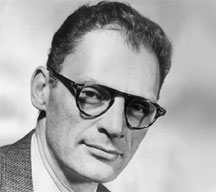
Arthur Miller

Arthur Miller
A leading 20th century American playwright and screenwriter

  • Full Name: Arthur Asher Miller
  • Birth: October 17, 1915
  • Death: February 10, 2005
  • Place of Birth: Harlem, New York City, USA
  • Place of Death: Roxbury, Connecticut, USA
  • Cause of death: Heart Failure
  • Buried at: Roxbury Center Cemetery, Roxbury, Connecticut
  • Religion: Jewish
  • Father: Isidore Miller
  • Mother: Augusta Barnett
  • Siblings: One older brother:  Matthew Kermit and a younger sister:  Joan Copeland
  • Marriage: Married thrice: Mary Grace Slattery  in August 5, 1940, Marilyn Monroe in June 29, 1956, Inge Morath in February 17, 1962
  • Number of Children:  He had four children, Jane and Robert A. Miller with Slattery and Rebecca Miller and Daniel with Morath.
  • Education: BA Journalism, University of Michigan (1938)
  • Known for: his awareness of portraying social realities of life
  • Criticised for: his scandalous life story
  • Influences: Henrik Ibsen
  • Influenced: NA

Quote:

I think the tragic feeling is invoked in us when we are in the presence of a character who is ready to lay down his life, if need be, to secure one thing -- his sense of personal dignity.
Arthur Miller, "Tragedy and the Common Man"

Major Themes:

  • American dream/ self-delusion
  • Social and economic pressure
  • Value of human life
  • Illusion versus reality
  • Vengeance
  • The mentality of working class Americans
  • Responsibility to others
  • Generation gaps: old people vs. young people
  • Vulnerability of human existence in the modern era

Notable Works:

  • Honors at Dawn (1936)
  • The Man Who Had All the Luck (1944)
  • All My Sons (1947)
  • Death of a Salesman (1949)
  • The Crucible (1953)
  • A Memory of Two Mondays (1955)
  • A View from the Bridge (1955)
  • After the Fall (1964)
  • Incident at Vichy (1965)
  • The Price (1968)
  • The Creation of the World and Other Business (1972)
  • The Archbishop's Ceiling (1977)
  • The American Clock (1981)
  • Elegy For a Lady (1982)
  • Some Kind of Love Story (1982)
  • Danger: Memory!: Two Plays (I Can't Remember Anything and Clara) (1986)
  • The Ride Down Mt. Morgan (1991)
  • The Last Yankee (1993)
  • Broken Glass (1994)
  • Mr. Peters' Connections (1998)
  • Resurrection Blues (2004)

Did You Know?

  • Arthur Miller’s father, Isidore Miller was a women's clothing manufacturer.
  • Isidore Miller was an illiterate Jewish immigrant from Poland.
  • Miller's family lost almost everything in the Stock Market Crash of 1929.
  • After high school graduation Miller worked a few odd jobs in order to save money for his education at University of Michigan.
  • Miller's debut Broadway play, The Man Who Had All the Luck (1944), was a great failure and closed after only four performances.
  • All My Sons (1947) became Miller's first success on Broadway and earned him his first Tony Award.
  • Miller alleged to be a life-long atheist.
  • Among Miller's most prestigious awards, are Emmy Awards, Tony Awards and a Pulitzer Prize for Drama.
  • A View from a Bridge (1955), one of Miller's best one-act plays was modified in 1956 to include two acts.
  • Arthur Miller married three times: Mary Slattery (1940-1956), Marilyn Monroe (1956-1961), and Inge Morath (1962-2002). He had two children with Slattery (Jane and Robert) and two more with Morath (Rebecca and Daniel). He did not have any children with Monroe.
  • The playwright and Monroe divorced less than two years before the famous actress died
  • In 1961, the year Miller and Monroe got divorced, Monroe starred in her last film The Misfits, which was based on the original screenplay by Miller.
  • Miller's daughter Rebecca married Academy Award winning actor Daniel Day-Lewis.
  • Miller's youngest son was born with Down Syndrome.
  • Miller decided to get married for the fourth time with the 34 year old minimalist painter Agnes Barley, but the plan failed as he died of heart failure.
  • Miller is buried with his wife Inge in Roxbury Center Cemetery, Roxbury, Connecticut.  Their grave is marked by an irregular granite upright marker and they each have flat granite foot markers.
  • Death of a Salesman was his first critically accepted play. It was opened on Broadway in 1949. The Play brought him three praiseworthy awards such as, the Pulitzer Prize, the New York Drama Critics' Circle Award and a Tony Award.
  • Miller’s play The Crucible (1953), although concerned with the Salem witchcraft trials, was actually an allegory of contemporary witch hunt plotted by Senator Joseph McCarthy in the early 1950s to blacklist the alleged communists from the government and other areas of American life.
  • Three years after The Crucible, in 1956, he was convicted of contempt of court for not revealing the names of Communist Party members before McCarthy's committee (House of Representatives' Committee on Un-American Activities).
  • Miller wrote the screenplay for the production of a film version of The Crucible (1996).
  • The film version of The Crucible was not as well received as was the play.
  • His last play of note was The Price (1968), a piece about family dynamics.


References
“Arthur Miller.” Microsoft Encarta. DVD-ROM. Redmond: Microsoft, 2005.

“Arthur Miller Biography.” Bio. True Story. 1996–2013. A+E Television Networks, LLC.
25 November 2012
< http://www.biography.com/people/arthur-miller-9408335>.

“Biography of Arthur Miller.” GradeSaver. 1999-2013. GradeSaver LLC. 25 November 2012
< http://www.gradesaver.com/author/arthur-miller/>.

 “Fun Arthur Miller Facts.” Life123. 2013. Life123, Inc. 25 November 2012
< http://www.life123.com/>.

January 12, 2013

Seamus Heaney

Seamus Heaney

Irish poet, essayist, critic, playwright, editor, translator, lecturer and the winner of the Nobel Prize in Literature.
  • Full Name: Seamus Justin Heaney
  • Pseudonym: Incertus   
  • Birth: 13 April 1939
  • Place of Birth: Northeast of Belfast in Northern Ireland
  • Father: Patrick Heaney
  • Mother: Margaret Kathleen Heaney (née McCann)
  • Siblings: two sisters and six brothers
  • Marriage: 1965
  • Spouse: Marie Devlin
  • Number of Children: 03
  • Education: St. Columb's College, Queen's University
  • Known for: his poetry which is noted for its portrayal of beautiful surroundings of Irish rural life as well as for its glimpse into the Irish historical and political events
  • Criticised for: for being an apologist and mythologizer
  • Influences:  T. S. Eliot, Robert Frost, Wilfred Owen, William Butler Yeats, William Shakespeare, Patrick Kavanagh, Derek Mahon, George Byron, Geoffrey Chaucer, Herbert McCabe, John Keats, John Millington Synge, William Wordsworth, John Montague
  • Influenced: Nick Laird, Eavan Boland

Quote:

“Poetry cannot afford to lose its fundamentally self-delighting inventiveness, its joy in being a process of language as well as a representation of things in the world.” Seamus Heaney, The Redress of Poetry

Major Themes:

  • Nature
  • Love
  • The relationship between contemporary issues and historical patterns
  • Legend and myth

Notable Works:

Poetry Collections
  • Death of a Naturalist, Oxford University Press, 1966.
  • Door into the Dark, Oxford University Press, 1969.
  • Wintering Out, Faber, 1972, Oxford University Press, 1973.
  • North, Faber, 1975, Oxford University Press, 1976.
  • Field Work, Farrar, Straus, 1979.
  • Poems: 1965-1975, Farrar, Straus, 1980.
  • (Adapter) Sweeney Astray: A Version from the Irish, Farrar, Straus, 1984.
  • Station Island, Farrar, Straus, 1984.
  • The Haw Lantern, Farrar, Straus, 1987.
  • New and Selected Poems 1966-1987, Farrar, Straus, 1990.
  • Seeing Things: Poems, Farrar, Straus, 1991.
  • The Midnight Verdict, Gallery, 1993.
  • The Spirit Level, Farrar, Straus, 1996.
  • Opened Ground: Selected Poems 1966-1996, Farrar, 1998.
Poetry Chapbooks
  • Eleven Poems, Festival Publications (Belfast), 1965.
  • (With David Hammond and Michael Longley) Room to Rhyme, Arts Council of Northern Ireland, 1968.
  • A Lough Neagh Sequence, edited by Harry Chambers and Eric J. Morten, Phoenix Pamphlets Poets Press (Manchester), 1969.
  • Boy Driving His Father to Confession, Sceptre Press (Surrey), 1970.
  • Night Drive: Poems, Richard Gilbertson (Devon), 1970.
  • Land, Poem-of-the-Month Club, 1971.
  • Servant Boy, Red Hanrahan Press (Detroit), 1971.
  • Stations, Ulsterman Publications (Belfast), 1975.
  • Bog Poems, Rainbow Press (London), 1975.
  • (With Derek Mahon) In Their Element, Arts Council of Northern Ireland, 1977.
  • After Summer, Deerfield Press, 1978.
  • Hedge School: Sonnets from Glanmore, C. Seluzichi (Oregon), 1979.
  • Sweeney Praises the Trees, (New York), 1981.
Prose
  • The Fire i' the Flint: Reflections on the Poetry of Gerard Manley Hopkins, Oxford University Press, 1975.
  • Robert Lowell: A Memorial Address and Elegy, Faber, 1978.
  • Preoccupations: Selected Prose 1968-1978, Farrar, Straus, 1980.
  • The Government of the Tongue: Selected Prose, 1978-1987, Farrar, Straus, 1988.
  • The Place of Writing, Scholars Press, 1989.
  • The Redress of Poetry, Farrar, Straus, 1995.
Editor
  • (With Alan Brownjohn) New Poems: 1970-71, Hutchinson, 1971.
  • Soundings: An Annual Anthology of New Irish Poetry, Blackstaff Press (Belfast), 1972.
  • Soundings II, Blackstaff Press, 1974.
  • (With Ted Hughes) The Rattle Bag (poetry), Faber, 1982.
  • The Essential Wordsworth, Ecco Press, 1988.
  • Also editor of The May Anthology of Oxford and Cambridge Poetry, 1993.
Other
  • (With John Montague) The Northern Muse (sound recording), Claddagh Records, 1969.
  • (Contributor) The Writers: A Sense of Ireland, O'Brien Press (Dublin), 1979.
  • Advent Parish Programme, State Mutual Book & Periodical Service, 1989.
  • Lenten Parish Programme: Renewal of Personal & Community Life through Prayer and Scripture, State Mutual Book & Periodical Service, 1989.
  • The Cure at Troy: A Version of Sophocles Philotetes (drama), Farrar, Straus, 1991.
  • Crediting Poetry: the Nobel Lecture, Farrar, Straus, 1996.
  • (Translator) Beowulf, Farrar, Straus & Giroux, 1999.

Did you Know?

  • Heaney also wrote several works under the pseudonym Incertus
  • His first collection of poetry was Death of a Naturalist (1966)
  • Heaney translated several important literary works
  • In the year 1995 he won the Nobel Prize in Literature
  • Heaney was born on a fifty-acre farm called Mossbawn in the townland of Tamniarn, County Derry, Northern Ireland
  • He grew up as a country boy and attended local school
  • At present he resides in Dublin
  • Heaney's poems first came to public attention in the mid-1960s when he was active as one of a group of poets who were subsequently recognized as constituting something of a "Northern School" within Irish writing
  • Heaney departed from Mossbawn at the age of 12 after securing a scholarship to St. Columb's College, a Catholic boarding school situated in the city of Derry
  • Heaney's departure from his birthplace could not detach him from its memory since much of his poetry is about country life
  • Heaney's brother, Christopher, was killed in a road accident at the age of four while Heaney was studying at St. Columb's College
  • Heaney wrote two of his poems: Mid-Term Break and The Blackbird of Glanmore in memory of Christopher
  • Heaney's study of Latin and Irish at St. Columb's College and subsequently Anglo-Saxon at Queen's University played an important role in the development of his poetic career
  • In recent years, he has been the recipient of several honorary degrees; he is a member of Aosdana, the Irish academy of artists and writers, and a Foreign Member of The American Academy of Arts and Letters
  • Heaney has attracted a readership on several continents and has won prestigious literary awards in England, Ireland, and the United States
  • Heaney did well, and in 1957 he entered Queen’s University, Belfast, where he had been offered another scholarship, this time to study for a degree in English Language and Literature
  • Although the Head of English at Queen’s encouraged Heaney to apply to Oxford to complete his postgraduate study, lack of confidence led him to opt to go to St. Joseph’s College for postgraduate course
  • After graduating from Queen’s University, Belfast in 1961, Heaney taught secondary school for a year and then lectured in colleges and universities in Belfast and Dublin
  • In the course of his career, Seamus Heaney has always contributed to the promotion of artistic and educational causes, both in Ireland and abroad
  • He was both the Harvard and the Oxford Professor of Poetry
  • Heaney was made a Commandeur de l'Ordre des Arts et Lettres in 1996
  • Besides being a Nobel Prize winner in Literature, Heaney also received the Geoffrey Faber Memorial Prize (1968), the E. M. Forster Award (1975), the PEN Translation Prize (1985), the Golden Wreath of Poetry (2001), T. S. Eliot Prize (2006) and two Whitbread Prizes (1996 and 1999)
  • Heaney was awarded the Lifetime Recognition Award from the Griffin Trust For Excellence In Poetry on June 6, 2012

Media Collection

Photos
Seamus Heaney

Seamus Heaney

Seamus Heaney

Seamus Heaney with his wife Marie, and children, c.late 70s.


Seamus Heaney

Seamus Heaney

Seamus Heaney
Videos


References

 “Seamus Heaney.” Wikipedia. 2012. Wikimedia Foundation, Inc. 25 November 2012
< http://en.wikipedia.org/wiki/Seamus_Heaney>.

“Seamus Heaney.” Encyclopædia Britannica. 2012. Encyclopædia Britannica, Inc., Inc.
25 November 2012 
< http://www.britannica.com/EBchecked/topic/258249/Seamus-Heaney>.

“Seamus Justin Heaney.” Gale Cengage Learning. 2012. Cengage Learning, Inc.
25 November 2012 
< http://www.gale.cengage.com/free_resources/poets/bio/heaney_s.htm>.

“The Nobel Prize in Literature 1995: Seamus Heaney.” Nobelprize.org. 1995.
The Nobel Foundation. 25 November 2012 
< http://www.nobelprize.org/nobel_prizes/literature/laureates/1995/heaney-bio.html>.

January 6, 2013

ARTHUR MILLER (1915 – 2005), AMERICAN PLAYWRIGHT AND ESSAYIST

Quotations by Arthur Miller

"I think the tragic feeling is invoked in us when we are in the presence of a character who is ready to lay down his life, if need be, to secure one thing -- his sense of personal dignity."
~ Arthur Miller, Tragedy and the Common Man

"A man is not an orange. You can't eat the fruit and throw the peel away."
~ Arthur Miller, Death of a Salesman

"The need of man to wholly realize himself is the only fixed star."
~ Arthur Miller, Tragedy and the Common Man

"Cleave to no faith when faith brings blood."
~ Arthur Miller, The Crucible, act II

"A small man can be just as exhausted as a great man."
~ Arthur Miller, Death of a Salesman

"Theology, sir, is a fortress; no crack in a fortress may be accounted small."
~ Arthur Miller, The Crucible

"Success, instead of giving freedom of choice, becomes a way of life. There's no country I've been to where people, when you come into a room and sit down with them, so often ask you, "What do you do?" And, being American, many's the time I've almost asked that question, then realized it's good for my soul not to know. For a while! Just to let the evening wear on and see what I think of this person without knowing what he does and how successful he is, or what a failure. We're ranking everybody every minute of the day."
~ Arthur Miller, Paris Review, Summer 1966

"One had the right to write because other people needed news of the inner world, and if they went too long without such news they would go mad with the chaos of their lives."
~ Arthur Miller, The Shadows of the Gods

"I do not believe that any work of art can help but be diminished by its adherence at any cost to a political program ... and not for any other reason than that there is no political program -- any more than there is a theory of tragedy -- which can encompass the complexities of real life."
~ Arthur Miller, Introduction to Collected Plays

"The Jungle is dark but full of diamonds."
~ Arthur Miller, Death of a Salesman

"I think it's a mistake to ever look for hope outside of one's self."
~ Arthur Miller, After the Fall

"Cleave to no faith when faith brings blood."
~ Arthur Miller, The Crucible

"Society is inside of man and man is inside society, and you cannot even create a truthfully drawn psychological entity on the stage until you understand his social relations and their power to make him what he is and to prevent him from being what he is not. The fish is in the water and the water is in the fish."
~ Arthur Miller, The Shadows of the Gods

"Maybe all one can do is hope to end up with the right regrets."
~ Arthur Miller, The Ride Down Mt. Morgan

"The shadow of a cornstalk on the ground is lovely, but it is no denial of its loveliness to see as one looks on it that it is telling the time of day, the position of the earth and the sun, the size of our planet and its shape, and perhaps even the length of its life and ours among the stars."
~ Arthur Miller, The Shadows of the Gods

October 11, 2012

Preamble

Expressionism was an avant-garde literary and artistic movement developed in Germany at the beginning of the 20th century. The term was first employed by the French painter, Julien-Auguste Hervé in 1901 and was subsequently applied to literature by Hermann Bahr in 1914. It came out as a revolt against Naturalism, which always searched for a precisely detailed realism. The expressionists, on the other hand, wanted to produce and make vivid their very own reality or their inner idea or vision of what they saw. They were more imaginative in handling of their subject matter. To them it was totally meaningless to produce a sole imitation of the world, and it is the very attitude (i.e. turning away from the physical reality) for which Expressionism could be deemed as the revival and development of the Romantic tradition. Expressionist drama introduced to a new approach to staging, scene design, and directing. Apart from drama, Expressionism is exhibited in many literary forms, including novel, short story, poetry, etc. The movement declined in 1930 with the rise of Adolf Hitler. Though existed for a short period, the movement exerted an epoch-making influence on modern art and literature.

Definition

Akin to romanticism, expressionism is not easy to define. In fact, there are no yardsticks to define it in a precise term. Generally speaking, in expressionistic literature the author seeks to depict a character’s or his own emotional experience by representing the world or nature as it appears to his state of mind rather than to present the world or nature in a realistic way. In other words, in Expressionism the author’s or the character’s subjective/private emotions and responses to a subject are emphasized rather than the objective surface reality of the subject. Lucidly speaking, the expressionists tend to transform nature rather than directly imitating it. For this reason, the depiction in Expressionistic works is a fantastic distortion or altered representation of reality as the author or the character reshapes the objective image into his mind's image (subjective image) to depict his own version of reality. Sometimes the author or his character suffers from a psychological conflict, such as depression or paranoia, which helps to alter his perception of reality.

Characteristics

There is no specific model or theory to distinguish the mode and temperament of the expressionist school of literature since the works of this movement represent a wide range of subjects. However, the major tenets of Expressionism are roughly as follows:  

Subjectivity: Expressionistic play tends to display an artist's internal, subjective experience to the world which is dominated by his own interpretation.  

Abstraction: It is the act of considering or evaluating something in terms of general characteristics or qualities apart from specific objects and concrete realities. Expressionistic play employs this device in its every aspect, such as plot, structure, setting, atmosphere, characters, etc. to provide a distorted view. Such a distortion helps to create a more personalized/imaginative reality from the visual world.  

Setting and Atmosphere: The setting and atmosphere in such play is vividly dreamlike, non-realistic, grotesque and nightmarish, where the depiction of life and the world is not photographically accurate as it often reflects the character’s state of mind which is often emotional, troubled, or abnormal.  

Plot and Structure: The plot and structure of the play tends to be disjointed and broken into episodes, incidents and tableaux, each making a point of its own. Instead of the dramatic conflict of the well made play, the emphasis was on a sequence of dramatic statements made by the dreamer, usually the author himself.  

Dialogue: The dialogue is often spoken in a sort of telegraphic style usually formed of short phrases of one or two words or expletives. Sometimes it also takes the form of long lyrical/poetic monologues.  

Unorthodox Characterization: the characters are developed as everyman since they are often represented as social groups/masses rather than particular person. Such characters were merely identified by nameless labels, such as The Man, The Father, The Son, The Billionaire, etc.  

Psychoanalysis: Freud’s theory of psychoanalysis provided many incentives for the expressionists to explore the subconscious forces in man. This becomes obvious in those plays where the study of deep and dark areas of the human soul gets priority.  

Pessimism: The expressionistic play depicts the hollowness, meaninglessness, loneliness and isolation of modern man’s life in mechanical, industrial, acquisitive society, which definitely points towards a pessimistic view of the human condition.  

Human Concerns: The writers sought to encapsulate the basic problems and issues of modern society with a view to reform it. These include:
  • Oppression, war, dehumanization, anarchy, political instability, sex pervasion.
  • Man’s predicament, struggle, sorrow and suffering.
  • Stress on mankind, on human values, and on the spiritual brotherhood of man.

Chief Representatives

It is a strange fact that although the Movement was developed in Germany, most of its precursors were not from German descendent. Moreover, several non-Expressionist writers also wrote literary works with Expressionistic note. Even after the decline of this movement, there were subsequent expressionist works from German and non-German writers.

Early Influences

The development of Expressionism was engendered by the following contributors:

August Strindberg (1849 – 1912)

August Strindberg

Swedish dramatist and novelist, whose work is characterized by its dark pessimism and dominance of emotion, instinct, and passion. Strindberg experimented with expressionistic ideas much earlier than the constitution of the expressionistic school of thought. He is, in fact, the forefather of Expressionism. Major expressionist plays by this author include To Damascus (1898-1904), The Dance of Death (1901), and The Dream Play (1902).  

Sigmund Freud (1856 – 1939)

Sigmund Freud

Austrian physician, neurologist, and founder of psychoanalysis, a theory claiming that much of our thinking and acting is strongly influenced by unconscious processes, such as innate sexual and aggressive drives. Freud's psychoanalytical approach played an important role in the development of Expressionistic School of thought.  

Carl Gustav Jung (1875 – 1961)

Carl Gustav Jung

Swiss psychiatrist, who is credited to be the founder of the analytical school of psychology. Jung expanded Freud's psychoanalytical approach, interpreting mental and emotional disturbances as an attempt to find personal and spiritual wholeness. His researches also provided much stimulus for the growth of the Expressionistic School of thought.

German Expressionists

Historians identify two different phases of Expressionism having independent principles of their own:

1. Mysticism/Pure Expres­sionism: The major themes of Mysticism was personal struggle, the everyman, and God. The Mystics prioritized the need for achieving personal emancipation rather than directing a social protest. The chief leaders of this phase include:  

Reinhard Johannes Sorge (1892 – 1916)

Reinhard Johannes Sorge

German dramatist and poet, whose work is noted for its pessimism. He is best known for writing the Expressionist play The Beggar (Der Bettler), which won the Kleist Prize in 1912.  

Fritz von Unruh 1885 – 1970

Fritz von Unruh

German dramatist, poet, and novelist. Amongst many of his plays Offiziere (Officers, 1911), Ein Geschlecht (A Family, 1916), and its sequel Platz (Place, 1920) are considered to be his best Expressionist works.

2. Activism: The activists, counter to the mystics, opted to explore the oppression, dehumanization and political issues of the time with a view to enacting a strong social reform. From this point of view their outlook could be identified as rational. The notable literary artists from this phase encompassed the following authors:  

Ernst Toller (1893 – 1939)

Ernst Toller

German playwright, who wrote plays of social protest in the style of expressionism. Best of his Expressionist works include Masses and Man (1920; trans. 1923, Brokenbow (1924; trans. 1926), Hoppla! Such Is Life! (1927; trans. 1928), and Pastor Hall (1939).
  
Georg Kaiser (1878 – 1945)

Ernst Toller

German dramatist, whose work deals with the impact of the modern machine age. Major Expressionistic drama by this dramatist include Morn to Midnight (1916; trans. 1922) and Der Silbersee (The Silver Lake, 1933).

Non-German Expressionists

Austrian (Czech) Expressionists

Franz Viktor Werfel (1890 – 1945)

Franz Viktor Werfel

Czech-born novelist, playwright, and poet, whose works deal with psychoanalysis, human behaviour, historical events, religious faith, heroism, human brotherhood and people’s way of dealing with values and ethical norms. Werfel became one of the chief representatives of Expressionism through his poetry. His subsequent works were mostly novels and dramas. Influenced by Expressionism in German drama, Werfel wrote The Goat Song (1921).  

Franz Kafka (1883 – 1924)

Franz Kafka

Czech novelist and short-story writer, whose central theme is various psychological conflicts, such as loneliness, and frustration reflected either in his central characters or in the society. His best works include The Metamorphosis (1915; trans. 1937), In the Penal Colony (1919; trans. 1941), The Trial (1925; trans. 1937), The Castle (1926; trans. 1930), and Amerika (1927; trans. 1938).
American Expressionists

Eugene Gladstone O'Neill (1888-1953)

Eugene Gladstone O'Neill

American playwright, whose The Emperor Jones (1920), The Hairy Ape (1922) and The Great God Brown (1926), were influenced by Expressionism. 

T.S. Eliot (1888-1965)

T.S. Eliot

Anglo-American poet and critic, whose work is mostly concerned with the spiritual bankruptcy of contemporary society. He is often labelled as an Expressionist for his long poem The Waste Land (1922).

Elmer Leopold Rice (1892-1967)

Elmer Leopold Rice

American dramatist, noted for his expressionist plays, including The Adding Machine (1923) and Street Scene (1929).  

Tennessee Williams (1911-1983)

Tennessee Williams

American playwright, novelist, essayist, short story writer, screenwriter, and poet who is renowned for his psychologically complex dramas that explore isolation and miscommunication within families and small groups of misfits and loners. Nowadays, his reputation rests on his three award-winning dramas—The Glass Menagerie (1944), A Streetcar Named Desire (1947), and Cat on a Hot Tin Roof (1955).  

Arthur Miller (1915-2005)

Arthur Miller

American dramatist, much of whose play is conveyed expressionistically. Miller's major achievement in Expressionistic style was Death of a Salesman (1949) which won the 1949 Pulitzer Prize for drama and the 1949 New York Drama Critics' Circle Award for best play of the year.
Irish Expressionists

Seán O'Casey (1880-1964)

Seán O'Casey

 Irish dramatist, whose successful plays exhibit a mastery of language and an unsentimental sympathy for the poor. His later plays were more expressionistic, they include The Silver Tassie, Within the Gates (1934), Purple Dust (1940), Red Roses for Me (1942), and The Bishop's Bonfire (1955).  

James Joyce (1882-1941)

James Joyce

Irish author, whose work is marked for its psychological insight and inventive language. Joyce is considered as an Expressionist for his best known epic novel Ulysses (1922), which uses stream of consciousness.

References


“An Introduction to Expressionism.” Academia.edu. 2012. Academia. 2 September 2011
< http://fh-wuerzburg.academia.edu/IngoPetzke/Papers/1520573/An_Introduction_to_Expressionism>

“Expressionism (Literature).” Talktalk. 2012. Tiscali. 20 September 2012
< http://www.talktalk.co.uk/reference/encyclopaedia/hutchinson
/m0097410.html>

“Expressionism.” Wikipedia. 2012. Wikimedia Foundation, Inc. 2 September 2012
< http://en.wikipedia.org/wiki/Expressionism>

 “Expressionism.” Infopleae. 2012. Pearson Education. 20 September 2012
< http://www.infoplease.com/ce6/ent/A0858069.html>

“Expressionism.” Quizlet. 2011. Quizlet LLC. 20 September 2012
< http://quizlet.com/11710951/world-theatre-and-drama-iii-midterm-flash-cards>

“Expressionism.” Museum-Online. 2011. Museum-Online. 2 September 2012
< http://www.museum-online.ru/en/Epoch/Expressionism/>

“Franz Werfel.” Kirjasto. 2011. Petri Liukkonen & Ari Pesonen & Kuusankosken
kirjasto. 2 September 2008
< http://www.kirjasto.sci.fi/fwerfel.htm>

“Literary Terms.” Cummings Study Guide. 2012. Michael J. Cummings.
20 September 2012
< http://www.cummingsstudyguides.net/xLitTerms.html>

Syed, J. W..“Expressionism In The Twentieth Century Literature.” Iqbal. 2012.
Iqbal. 20 September 2011
< http://www.allamaiqbal.com/publications/journals/review/apr70/3.htm>


NB: This article was last modified on September 15, 2019

Random Articles