Oscar Wilde was an illustrious 19th-century Irish playwright, poet, and novelist.


“Oscar Wilde.” Wikipedia. 2020. Wikimedia Foundation, Inc.
“Oscar Wilde Biography”. The Biography.com website. 2020.

Profile
- Birth Name: Oscar Fingal O'Flahertie Wills Wilde
- AKA: Oscar Wilde
- Date of Birth: October 16, 1854
- Place of Birth: Dublin, Ireland
- Zodiac Sign: Libra
- Date of Death: November 30, 1900
- Died at Age: 46 Years
- Place of Death: Paris, France
- Place of Burial: Père Lachaise Cemetery, Paris
- Epitaph:
“And alien tears will fill for him
Pity's long-broken urn,
For his mourners will be outcast men,
And outcasts always mourn.”
Pity's long-broken urn,
For his mourners will be outcast men,
And outcasts always mourn.”
- Cause of Death: Meningitis
- Last Words: ‘My wallpaper and I are fighting a duel to the death. One or the other of us has to go’
- Ethnicity: White
- Nationality: Irish
- Father: Sir William Robert Wills Wilde (1815–1876)
- Mother: Jane Francesca Agnes, Lady Wilde (née Elgee) (1821–1896)
- Siblings:
- Older Brother: Willie Wilde (1852–1899)
- Younger Sister: Isola Wilde (b. 1856)
- Spouse: Constance Mary Wilde (née Lloyd) (b. 1859 –d. 1898; m. 1884 to until her death)
- Children:
- Son: Cyril Holland (born Cyril Wilde) (1885–1915)
- Son: Vyvyan Holland (born Vyvyan Oscar Beresford Wilde) (1886–1967)
- Alma Mater: Portora Royal School (1864-1971); Trinity College, Dublin (1871-1974); Magdalen College, Oxford (1874-1978)
- Occupation: Playwright, novelist, poet, editor, and critic
- Oscar Wilde is known for: his clever and hilarious social commentary
- Oscar Wilde is criticized for: homosexuality
- Oscar Wilde was influenced by: John Keats (1795-1821), Théophile Gautier (1811-1872), John Ruskin (1819-1900), Charles Baudelaire (1821-1867), Dante Gabriel Rossetti (1828-1882), William Morris (1834 -1896), James McNeill Whistler (1834-1903), Algernon Charles Swinburne (1837-1909), Walter Pater (1839-1894), John Pentland Mahaffy (1839-1919), John Addington Symonds (1849-1893), and Robert Baldwin "Robbie" Ross (1869-1918)
- Oscar Wilde’s works inspired: Max Beerbohm (1872-1956)
- Literary movement: Aesthetic movement, Decadent movement
Quotes
“The books that the world calls immoral are books that show the world its own shame.”
– Oscar Wilde, The Picture of Dorian Gray (1842)
“It is perfectly monstrous,' he said, at last, 'the way people go about nowadays saying things against one behind one's back that are absolutely and entirely true.”
– Oscar Wilde, The Picture of Dorian Gray (1842)
“In this world there are only two tragedies. One is not getting what one wants, and the other is getting it.”
– Oscar Wilde, Lady Windermere's Fan (1892)
Major Works
Essays
- "The Decay of Lying" (1989/ 1990)
- "Pen, Pencil and Poison" (1989/ 1990)
- "The Soul of Man under Socialism" (1991/1995)
- Intentions (1891)
- "Phrases and Philosophies for the Use of the Young" (1894)
- "A Few Maxims For The Instruction Of The Over-Educated" (1894)
Novel
- The Picture of Dorian Gray (1890/1891)
Stories
- "The Portrait of Mr. W. H." (1889)
- The Happy Prince and Other Tales (1888)
- A House of Pomegranates (1891)
- Lord Arthur Savile's Crime and Other Stories (1891)
Poems
- Ravenna (1878)
- Poems (1881)
- The Sphinx (1894)
- Poems in Prose (1894)
- The Ballad of Reading Gaol (1898)
Plays
- Vera; or, The Nihilists (1880)
- The Duchess of Padua (1883)
- Lady Windermere's Fan (1892)
- A Woman of No Importance (1893)
- An Ideal Husband (1895) (text)
- The Importance of Being Earnest (1895) (text)
Did You Know?
- Oscar Wilde was second of the three children born to Sir William Wilde and to Jane Wilde.
- William Wilde was an author and well-known ear and eye surgeon. He was knighted for his contribution as an assistant commissioner to the censuses of Ireland.
- Jane Wilde was a renowned poet and Irish nationalist.
- William Wilde had three offspring from his previous marriage; however, he kept them somewhere else with necessary support but never endorsed them as members of his family.
- Wild’s youngest sister, Isola died of meningitis at the age of ten. Wilde paid homage to her untimely demise through the poem Requiescat.
- Wilde attended the Portora Royal School at Enniskillen with his older brother Willie.
- In 1871, Wilde was awarded the Royal School Scholarship to attend Trinity College.
- After securing the highest honours at Trinity College, he also achieved another scholarship to study at Magdalen College in Oxford.
- At Magdalen College, he received the Newdigate Prize for his long poem Ravenna (1878).
- After graduating from Magdalen College, Wilde returned to Dublin for his childhood beloved Florence Balcombe, however, he went back to England when he found that she was engaged to marry fellow writer Bram Stoker.
- He published his first play, Vera, or The Nihilists in 1980 privately. It was a melodrama about the Russian revolutionaries.
- In 1881, at the age of 27, Wilde published his first collection of poetry, Poems at his own expense.
- On May 29, 1884, Oscar married Constance Lloyd who was a talented writer of Children's stories.
- To support his family Wilde occasionally lectured, wrote book reviews for newspapers and magazines, including the Pall Mall Gazette and the Dramatic Review.
- In 1888, he published his first work of prose, The Happy Prince, and Other Tales.
- In 1890, Wilde published the commercially successful The Picture of Dorian Gray, the only novel he ever wrote. Although this novel is widely read today, it received fierce criticism after publication.
- During his most productive period, Wilde began to mix with the literary circles that were often homosexual. He allegedly had his first homosexual affair with Robert Ross, the Canadian journalist, art critic, and art dealer.
- In 1891, Wilde met the poet Lord Alfred Douglas and involved in an intense love relationship. Their intimacy reached to a certain point that subsequently Wilde was convicted for homosexuality and sentenced for two years with hard labour.
- In 1897 he was released from prison and moved to France and stayed there until his death.
- Upon his release, he penned The Ballad of Reading Gaol, which reveals his concerns for inhumane prison conditions.
- The later period of his life was largely unproductive since he was unable to produce any notable works; he drank heavily and mostly spent his time visiting friends for monetary aid and living in cheap hotels.
- Even after the scandalous trial and imprisonment, Wilde and his wife never divorced. However, Constance changed her sons’ surname to “Holland” to keep them aloof from social humiliation.
- Wilde’s eldest son Cyril, who became a Captain in the Royal Field Artillery, went to fight in World War I and died.
- His youngest son, Vyvyan also went to World War I. Afterwards he worked as a translator for the BBC. In 1954, he authored an autobiography entitled Son of Oscar Wilde, wherein he mentioned that his father was a loving parent and he and his brother had a happy childhood.
- In 2008, Vyvyan's son, and Oscar Wilde’s only grandchild, Christopher Merlin Vyvyan Holland published A Portrait of Oscar Wilde.
- On November 30, 1900, just before his death, Wilde converted to Roman Catholicism.
- In 1909, his remains were disinterred from Cimetière de Bagneux and transferred to Père Lachaise Cemetery.
- Wilde’s tomb sculpture was crafted by Jacob Epstein upon commissioned by Robert Ross. Ross requested to keep a small chamber in the tomb for his own ashes. Ross's ashes were transferred into Wilde's tomb in 1950, on the 50th death anniversary Oscar Wilde.
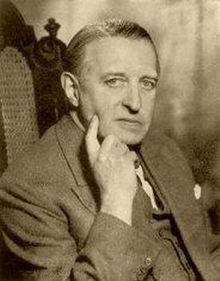
Media Gallery




References
Beckson, Karl. “Oscar Wilde”. Encyclopædia Britannica. 2020.
Encyclopædia Britannica, inc.11 April 2020
<https://www.britannica.com/biography/Oscar-Wilde>.
“Oscar Wilde.” Wikipedia. 2020. Wikimedia Foundation, Inc.
11 April 2020< https://en.wikipedia.org/wiki/Oscar_Wilde>.
“Oscar Wilde Biography”. The Biography.com website. 2020.
A&E Television Networks.11 April 2020
< https://www.biography.com/writer/oscar-wilde>.


